Study Physiotherapy in Turkey - Full Guide for International Students

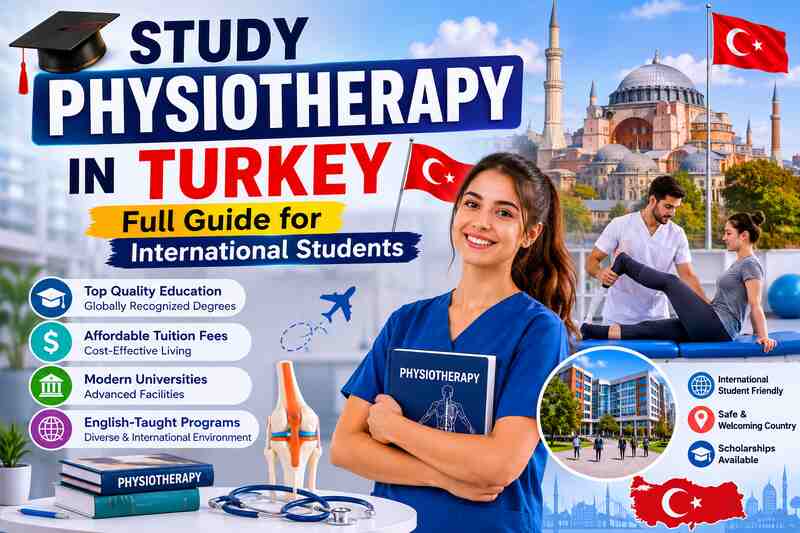
If you are thinking about studying physiotherapy in Turkey, you are looking at one of the smartest healthcare degree choices available to international students right now. The program is four years, admission to private universities requires no entrance exam, fees start from $2,900 per year, and the career it leads to has real, documented demand in the UAE, Saudi Arabia, Germany, and beyond. Every year our team processes applications for hundreds of health sciences students, and physiotherapy keeps coming up more and more. Students from Nigeria, Egypt, Pakistan, Libya, and Iraq are actively asking about it.
Once you understand what the physiotherapy and rehabilitation degree actually offers and where it can take you after graduation, the interest makes complete sense. This guide covers it all: the program structure year by year, specific university profiles with fees, clinical training quality, international career pathways with salary figures, how Turkey compares to other study destinations, and every practical question you have about applying.
What is Physiotherapy and Rehabilitation?
Physiotherapy, sometimes called physical therapy, is a four-year health sciences degree that trains students to assess, treat, and rehabilitate people with movement disorders, injuries, chronic diseases, neurological conditions, and physical disabilities. Graduates carry the protected professional title of Physiotherapist and are licensed healthcare workers in every country that has a formal health system.
The reason this field is growing globally is straightforward: aging populations, rising sports injuries, growing demand for post-surgical rehabilitation, and wider awareness of chronic pain management have all increased the need for qualified physiotherapists faster than most countries can train them. According to the World Physiotherapy organization, Turkey's national physiotherapy association has been a member since 1974 longer than many countries. That gives Turkish training a legitimacy signal that matters when international graduates apply to work abroad.
Three things make physiotherapy a particularly smart choice for students from the Middle East and Africa. First, it is a four-year bachelor's degree rather than six, so total tuition spend is lower than medicine or dentistry and you enter the workforce earlier. Second, demand in the Gulf is strong and growing the UAE has roughly four physiotherapists per 10,000 people and is actively recruiting internationally. Third, the skillset transfers across healthcare systems in a way that many other health degrees do not.
The 4-Year Physiotherapy and Rehabilitation Curriculum
The physiotherapy and rehabilitation program in Turkey runs eight semesters and awards graduates the Bachelor of Science in Physiotherapy and Rehabilitation plus the protected title of Physiotherapist. Total credit load is 240 ECTS, the European standard that gives the degree cross-border academic credibility.
Year 1 - Scientific Foundation
The first year establishes the medical science base that all clinical work depends on. Students cover human anatomy and neuroanatomy, physiology (organ systems, cardiopulmonary function, musculoskeletal mechanics), biochemistry and medical biology, kinesiology and biomechanics, medical terminology, introduction to physiotherapy and rehabilitation concepts, first aid and basic clinical skills, and medical genetics basics.
This year is demanding. Students with strong high school science backgrounds find it manageable. Students who struggled with biology and chemistry in school will feel the pressure -- come prepared.
Year 2 - Core Physiotherapy Science
Year 2 transitions from general medical science into the specific science of movement, injury, and therapeutic intervention. The curriculum covers musculoskeletal anatomy in depth, pathology of skeletal, muscular, nervous, and cardiovascular systems, physical therapy modalities (electrotherapy, hydrotherapy, heat and cold therapy), neuroscience and neurological rehabilitation introduction, clinical assessment tools, orthopedics fundamentals, exercise physiology, and research methodology.
Pre-clinical practice in on-campus physiotherapy labs begins in Year 2 at most universities. Students start applying assessment techniques on each other and in supervised practical sessions before moving to real patient environments.
Year 3 - Clinical Sciences and Specialized Physiotherapy Fields
Year 3 is where the program opens up into specialized areas. Students study musculoskeletal physiotherapy and orthopedic rehabilitation, neurological rehabilitation covering stroke, spinal cord injury, Parkinson's disease, and multiple sclerosis, cardiopulmonary rehabilitation for post-surgical patients and chronic respiratory disease, pediatric physiotherapy covering cerebral palsy and developmental conditions, gait analysis and prosthetics introduction, manual therapy techniques, sports physiotherapy covering injury prevention and return-to-sport protocols, and geriatric rehabilitation.
By Year 3, universities with strong hospital infrastructure have students in clinical rotations with real patient responsibility under supervision.
Year 4 - Advanced Clinical Internship
The final year is predominantly clinical. Students complete structured rotations through hospital physiotherapy units covering orthopedics, neurology, ICU, cardiology, and burns, outpatient rehabilitation clinics, sports medicine facilities, pediatric rehabilitation centers, and community health units.
One critical point for students planning international careers: the minimum threshold that UAE's DHA, Saudi Prometric, UK's HCPC, and Australia's AHPRA check when evaluating foreign-trained physiotherapy graduates is 1,000 documented clinical hours across diverse settings (musculoskeletal, neurological, and cardiopulmonary). This is a 2026 international benchmark. The strong programs in Turkey are structured to meet or exceed it. When evaluating universities, ask directly: how many hospital-based clinical hours does the program provide?
University Profiles and Physiotherapy Fees 2026
Istanbul Medipol University:
Medipol is the strongest clinical infrastructure among private Istanbul universities for physiotherapy students. The university operates Medipol Mega University Hospital, a 700-plus bed facility with dedicated physiotherapy and rehabilitation units covering neurology, orthopedics, sports medicine, burns, and intensive care. Students rotate through this hospital from Year 3, getting real clinical exposure in a major, well-equipped facility. The English-medium program runs all four years with English-taught theory and bilingual clinical supervision.
Physiotherapy fees at Medipol 2026:
English program: approximately $8,000-$9,000/year
Turkish program: approximately $7,500-$8,500/year
Istanbul Aydin University (IAU):
Aydin University's Faculty of Health Sciences runs a well-structured physiotherapy and rehabilitation program with a clear emphasis on combining scientific theory and clinical application. The university partners with Istanbul hospitals and rehabilitation centers for practical training. IAU is particularly popular among students from Arab countries because of its established international student support systems and strong track record with residence permit and document processing.
Physiotherapy fees at Aydin University 2026:
English program: approximately $5,500-$7,000/year
Turkish program: approximately $4,000-$5,500/year
Bahcesehir University (BAU):
BAU's physiotherapy and rehabilitation program trains students to work in specialized hospital units -- neurology, cardiology, intensive care, orthopedics -- at international quality standards. The university is ranked 801-1000 globally by Times Higher Education (2026) and fifth among Turkish universities in the same rankings, so the degree carries real weight. BAU also has a Master's program in Physiotherapy and Rehabilitation, giving students a clear specialization pathway within the same institution.
BAU also has international campus partnerships (Berlin, Washington, Batumi) and Erasmus+ exchange options for students wanting a semester abroad.
Physiotherapy fees at BAU 2026:
English program: approximately $5,172-$6,000/year
Turkish program: lower by $800-$1,200/year
Istanbul Gelisim University (IGU):
Gelisim is the best budget option for physiotherapy in Istanbul from a legitimate accredited university. Ranked 16th overall among Turkish universities and 9th among private universities, it is a real institution, not a diploma factory. The physiotherapy and rehabilitation program is offered in English and Turkish with hospital partnerships supporting clinical rotations.
Physiotherapy fees at Gelisim University 2026:
English program: approximately $4,000-$4,250/year
Turkish program: approximately $3,500/year
For students with a tight annual budget, Gelisim offers genuine value at a fraction of what Medipol or BAU charge.
Istanbul Kent University:
Kent's central Taksim location gives students unmatched access to Istanbul's healthcare network. The physiotherapy program is available in English and Turkish. Kent is specifically recognized by Jordan, Iraq, Egypt, Algeria, Lebanon, Yemen, Palestine, and Syria which makes it the right choice for students from those countries who are returning home to practice.
Physiotherapy fees at Kent University 2026:
English program: approximately $2,900/year (lowest in Istanbul for English-medium physiotherapy)
Turkish program: approximately $2,200/year
Other Universities Worth Considering
University | Annual Fee (English) | Annual Fee (Turkish) | Notable Feature |
|---|---|---|---|
Yeditepe University | ~$8,500/year | ~$5,000/year | Strong research environment, Kadikoy campus |
Istinye University | ~$8,000/year | ~$6,500/year | IstinyePark hospital network for clinical training |
Istanbul Atlas University | ~$5,900/year | ~$4,000/year | Curriculum built on World Physiotherapy and ENPHE standards |
Biruni University | ~$5,000/year | ~$3,500/year | Affordable, recognized internationally |
Istanbul Okan University | ~$4,000/year | ~$3,500/year | Budget option, English program available |
Fenerbahce University | ~$4,000/year | -- | English program, sports physiotherapy emphasis |
Nisantasi University | ~$6,500/year | ~$3,500/year | Modern campus, good English support |
Halic University | ~$3,500/year | ~$3,000/year | Budget option, Istanbul hospital partnerships |
Public universities including Hacettepe, Istanbul University-Cerrahpasa, and Gazi offer physiotherapy from $1,000-$4,000/year but require TR-YOS with competitive scores. Hacettepe in particular has strong international recognition but admission for international students is genuinely competitive.
There are several countries where you can study physiotherapy in English as an international student. So why choose Turkey?
The honest answer is the combination of factors.
Real clinical training infrastructure. Turkish private universities offering physiotherapy programs are not running students through classroom simulation and calling it clinical practice. Istanbul Medipol University sends physiotherapy students into Medipol Mega University Hospital from early in the program a facility with dedicated physiotherapy units covering orthopedics, neurology, cardiology, and sports rehabilitation. That is hands-on, real-patient experience, not mannequin practice.
Curriculum aligned with international standards. Istanbul Atlas University, for example, built its physiotherapy curriculum based on guidance from the World Physiotherapy Confederation, the European Physiotherapy Education Network (ENPHE), and Turkey's National Core Education Program (UÇEP). When a program is benchmarked against those bodies, it meets the clinical hours and content standards that licensing authorities in the UK, UAE, Saudi Arabia, and Germany check when evaluating foreign-trained physiotherapists.
Academic research backing. Research published in PubMed Central on Turkish physiotherapy and rehabilitation curricula confirms that programs integrate theoretical, practical, and clinical phases in a structured three-stage format, with growing inclusion of modern rehabilitation technologies and evidence-based practice frameworks. That academic legitimacy is what makes a degree citation-worthy internationally.
No entrance exam. Private universities in Turkey admit international physiotherapy students based on high school grades only typically a minimum 60% overall average. No YOS exam, no IELTS, no standardized test.
Fees are genuinely competitive. Studying physiotherapy in Turkey at a private Istanbul university costs $2,900 to $9,000 per year. Compare that to the UK (£15,000-£25,000/year for international students), Australia ($25,000-$40,000 AUD/year), or Malaysia ($8,000-$12,000/year). Turkey gives you an English-medium program with real hospital training at a fraction of those figures.
Country | Annual Tuition (International) | Duration | English Option | Key Advantage |
|---|---|---|---|---|
Turkey (private) | $2,900-$9,000 | 4 years | Yes | Affordable, real hospital clinical training, no entrance exam |
Turkey (public) | $1,000-$4,000 | 4 years | Limited | Very cheap, competitive TR-YOS required |
Malaysia | $5,000-$12,000 | 4 years | Yes | English-medium, known Gulf recognition |
Georgia | $3,000-$6,000 | 4 years | Yes | Cheap, limited hospital quality |
Romania | $3,000-$5,000 | 4 years | Yes | EU country, strong EU recognition |
Poland | $5,000-$9,000 | 4 years | Yes | EU country, strong recognition |
Hungary | $6,000-$10,000 | 4 years | Yes | EU country, growing reputation |
UK | £15,000-£25,000/year | 3 years | Yes | Best global recognition, expensive |
Australia | A$25,000-A$40,000/year | 4 years | Yes | Excellent recognition, high cost of living |
Turkey sits at a strong middle ground: significantly cheaper than Western Europe and the UK, better infrastructure and recognition track record than Georgia, and a degree structure that meets international clinical hours standards.
Admission to private Turkish university physiotherapy programs is genuinely accessible. Here is what you need:
High school diploma (minimum approximately 60% average)
Valid passport
Translated and certified copy of high school certificate
Passport-size photos
No entrance exam. No IELTS or TOEFL. No YOS. Applications open in January or February for September enrollment. Physiotherapy seats at popular Istanbul universities fill quickly do not wait until summer.
Our team processes applications to all the universities in this article with zero application fees on our side. The admission letter arrives within 24 hours of a complete document file. After that, we guide you through visa documentation, sworn translation and authentication of documents through our court-accredited Istanbul translation service, and after arrival -- VIP airport pickup, residence permit, university registration, and course selection.
This is the section most competing guides skip, and it is the most important one for students making a four-year investment.
In Turkey: Graduates can work in public and private hospitals, outpatient rehabilitation clinics, sports clubs, special education centers, occupational health units, and private practices. Starting monthly salaries in Turkey are modest most internationally trained students use the degree to access international markets.
In the UAE (Dubai and Abu Dhabi): This is where physiotherapy graduates from Turkey most often go. The UAE has roughly four physiotherapists per 10,000 people and the government's healthcare expansion is actively recruiting internationally. Entry-level physiotherapists in Dubai earn AED 4,000-8,000 per month (approximately $1,100-$2,200), tax-free. Mid-level (3-7 years experience): AED 10,000-18,000 per month. Packages typically include housing allowance, annual flights, and health coverage. To work in the UAE, graduates need DHA (Dubai Health Authority) or DOH (Abu Dhabi Department of Health) registration, which involves credential evaluation and a licensing exam.
In Saudi Arabia: Saudi Prometric registration is required for foreign physiotherapy graduates. Entry packages for internationally trained physiotherapists start at SAR 5,000-8,000 per month (approximately $1,300-$2,100), often with housing allowance included. Senior specialists in burns, neurological rehabilitation, or sports can earn SAR 20,000-40,000 per month. No income tax.
In Germany: There is a documented physiotherapist shortage in Germany and the country has established recognition pathways for foreign-trained physiotherapists. The process involves credential evaluation (Berufsanerkennung) through the relevant state authority. Working physiotherapists in Germany earn approximately 2,800-3,800 euros per month gross at entry to mid-level.
In the UK: The HCPC (Health and Care Professions Council) oversees physiotherapy registration for international graduates. The process requires credential evaluation, IELTS minimum 7.0 overall, and sometimes an adaptation period. Starting NHS salaries are around £28,000-£32,000 per year for Band 5 physiotherapists.
In Arab countries: Turkish physiotherapy degrees are generally recognized in Jordan, Egypt, Libya, Sudan, and Iraq through Ministry of Health registration processes with bilateral agreements in place.
Q: Is physiotherapy in Turkey a good career choice for international students? A: Yes, particularly for students targeting the Gulf, Germany, or Arab countries. Physiotherapy is a growing field globally, and Turkish-trained graduates have established career pathways into UAE, Saudi Arabia, Germany, Jordan, Egypt, and Libya. The four-year degree leads to a protected professional title that carries real weight on the international job market.
Q: Can I study physiotherapy in Turkey in English? A: Yes. Several universities offer fully English-medium physiotherapy programs, including Medipol, BAU, Aydin, Gelisim, Istinye, Kent, Atlas, Okan, and Biruni. English-taught programs cost $500-$1,500/year more than the Turkish equivalent at the same university.
Q: Do I need YOS or IELTS to apply for physiotherapy studies in Turkey? A: Not at private universities. Admission is based on high school grades only -- typically a minimum 60% average. No YOS exam, no IELTS, no standardized test required.
Q: How many years is the physiotherapy program in Turkey? A: Four academic years (eight semesters), totaling 240 ECTS credit hours. Graduates earn a Bachelor of Science in Physiotherapy and Rehabilitation and the Physiotherapist title. A two-year Master's is available afterward, and a PhD (Turkish medium only) is offered at several universities.
Q: Is a physiotherapy degree from Turkey recognized internationally? A: Generally yes, through the appropriate registration process in each country. The Turkish Physiotherapy Association has been a World Physiotherapy member since 1974, and Turkish programs aligned with ENPHE and UÇEP standards meet international benchmarks. Recognition pathways for UAE, Saudi Arabia, Germany, and the UK are established and well-documented.
Q: What salary can I expect as a physiotherapist in the Gulf after graduating from Turkey? A: Entry-level physiotherapists in the UAE earn AED 4,000-8,000 per month (approximately $1,100-$2,200 per month, tax-free). In Saudi Arabia, starting packages typically run SAR 5,000-8,000 per month, often with housing allowance. Both increase significantly with experience and specialization.
Q: What is the cheapest physiotherapy university in Turkey for English instruction? A: Istanbul Kent University offers the lowest English-medium physiotherapy fees among accredited Istanbul universities -- approximately $2,900/year. Gelisim University is next at around $4,000/year for the English program.
Q: Can physiotherapy graduates from Turkey work in Germany? A: Yes, through the Berufsanerkennung credential evaluation process. Germany has an established recognition pathway for physiotherapists and a documented shortage in the field.
Q: What is the 1,000-hour clinical standard and why does it matter? A: The minimum clinical hours threshold that UAE, Saudi Arabia, UK, and Australian licensing bodies check for foreign-trained physiotherapy graduates is 1,000 documented hours across musculoskeletal, neurological, and cardiopulmonary settings. Strong programs in Turkey are structured to meet or exceed this. When evaluating universities, ask how many hospital-based clinical hours the program provides.
Q: Can I specialize after my physiotherapy bachelor's in Turkey? A: Yes. Turkish universities offer two-year Master's programs in musculoskeletal physiotherapy, neurological rehabilitation, sports physiotherapy, cardiopulmonary rehabilitation, and pediatric physiotherapy. Full program costs run $3,000-$9,000 total -- significantly cheaper than UK or Australian equivalents.
The distance between reading this article and being enrolled in a physiotherapy program in Turkey is about six months of process: documents, visa, university confirmation, accommodation. Our team handles all of it.
We have been placing students in Turkish universities for over 21 years, processed more than 100,000 applications, and enrolled more than 10,000 students across health sciences programs including physiotherapy and rehabilitation. Our Istanbul office does the work on the ground -- VIP airport pickup, sworn translation through our court-accredited service, residence permit support, university registration.
Zero application fees. Admission letter within 24 hours. Apply at turkeyuniversity.org and our team will send you a personalized university comparison for physiotherapy programs based on your grades, budget, and career target within 24 hours.