Turkish Private Universities Recognition and Accreditation Guide 2026

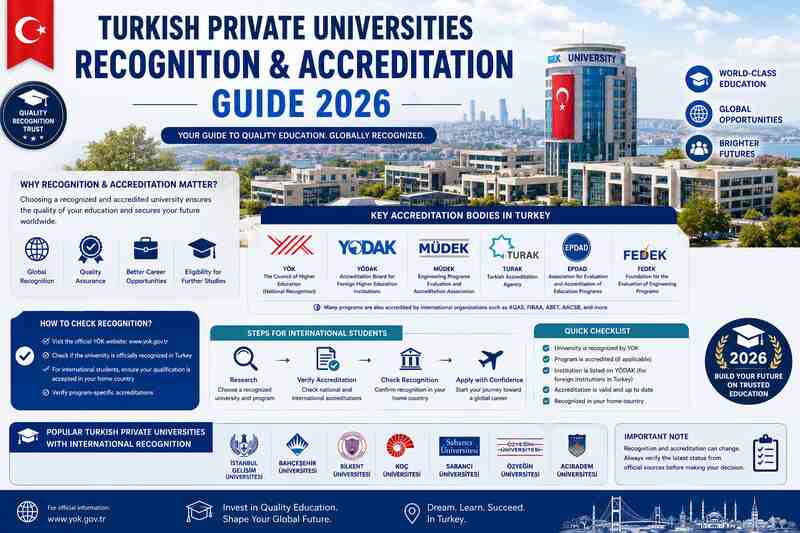
"Choosing where to study is a massive step. The real worry is: 'Will my degree actually work when I go home or move to another country?' This is why having a reliable Turkish Private Universities Recognition and Accreditation Guide 2026 is so important for anyone looking at Turkey. Knowing about International Recognition and Accreditations of Turkish Private Universities: What Do They Really Mean? is the first step to securing your future."
Over the last few years, a private Turkish university education has become a lot more respected worldwide. It is not just about being "officially open"; it is about quality. Many schools in Istanbul and Ankara now follow the same academic rules as top Western colleges. This is great news for anyone searching for accredited universities in Turkey, especially in tough fields like Medicine, Engineering, or Business.
In Turkey, every school is under YÖK (The Higher Education Council). That makes the degree legal, but for a global career, you need more. You need to know: are Turkish universities recognized in USA? or are they accredited Turkish universities in places like Canada or the Gulf? By 2026, many Turkish schools have earned specific labels like MÜDEK or AACSB. These are the "keys" that help you get a job or a Master's degree in the US, UK, or Europe.
We also see a lot of interest regarding Turkish universities accredited in Qatar and the Middle East, as well as students looking for accredited universities in Kazakhstan or accredited universities in Uzbekistan who want to use a Turkish degree as a bridge to a better career. Because Turkey follows the Bologna Process (the European standard), your credits are usually easy to transfer.
If you are seriously looking at private universities in Turkey for 2026, don’t waste your time jumping between a hundred different websites. Everything you actually need to know—whether it’s the latest university rankings, which programs have the best international accreditations, or what the current fees look like—is all in one place at https://www.turkeyuniversity.org/.
It’s way better to check a reliable source like this before you commit to anything. It lets you compare schools side-by-side so you can see which one actually fits your career goals and gives you that global recognition you're after. Instead of guessing, just head to the site, get the full breakdown, and make sure you’re choosing a university that’s actually going to open doors for you later on. It makes the whole process a lot less stressful and much more organized.
Why International Recognition Matters for Private Turkish Universities
For many international students who plan to study abroad, one question is always coming again and again: are Turkish degrees really accepted worldwide? In 2026, this is more important than ever because the job market is getting very competitive. Employers now check more than just the name on your degree; they look for the credibility and the background of where you studied.
When you search for accredited universities Turkey or ask "Are Turkish universities recognized in USA?", you might get mixed answers. The truth is, while almost all schools have general recognition, the real "game-changer" for your career is the specific accreditation of your program. A private Turkish university doesn't just settle for local approval; they push for global "Golden Seals" that prove your education matches top Western standards. Here is why this international standing matters so much:
Program-Specific Accreditations: Private schools in Turkey work hard for international labels like MÜDEK for engineering, STAR for social sciences, and TEPDAD for medicine. These accreditations are what actually open doors when you apply for a job in Europe or the UK.
Global Reach & Trust: Because of strong global partnerships, many accredited Turkish universities are now fully recognized in the USA, Canada, and the UK. This makes it much easier to continue your Master’s abroad or get a professional license without a headache.
The European Standard (Bologna Process): Turkey is part of the European Higher Education Area. This means your degree comes with ECTS credits and a Diploma Supplement in English. It’s like having a universal "academic passport" that works across all of Europe.
Recognition in the Gulf & Asia: It’s not just about the West. In 2026, there is a huge list of Turkish universities accredited in Qatar, the UAE, and Jordan. Also, for students from Central Asia, these schools are becoming the top choice for those looking for accredited universities in Kazakhstan and Uzbekistan through dual-diploma options.
Rankings vs. Reality: While many institutions appear in the QS and THE rankings, smart students look deeper. They check the quality of research and modern facilities. Even though tuition fees are much lower than in the US (ranging from $3,000 to $15,000), you are still getting a degree with full International Recognition.
In the end, success is not just about a high ranking. It’s about choosing a school where the degree actually "travels" with you. Investing in a private Turkish university with the right accreditations is a smart move for your career, no matter where in the world you end up working.
When you start searching for things like "are Turkish universities recognized internationally," what you are usually asking about is general recognition. Basically, this just means if the university is officially "legal" in the eyes of the government. In Turkey, almost every school—whether we are talking about public or private universities in Turkey—is recognized by YÖK (The Higher Education Council). This is great because it means your diploma is a real, legal document.
But here is where it gets a bit confusing. Just because a degree is "recognized" doesn't mean it is the same as being "accredited." I always explain it to students this way:
Recognition (The Legal Part): This is the foundation. It means the university is officially registered. Without this, your degree is basically just a piece of paper.
Accreditation (The Quality Part): This is where it gets interesting. Accreditation is an extra "stamp of approval" from international organizations. It proves that the lessons, the teachers, and the labs meet global standards.
So, when people ask, "are Turkish degrees recognised in UK?" or Europe, the answer is a bit deeper than a simple yes. While the recognition is your first step, the actual "weight" of your degree when you apply for a job depends on the accreditation.
In 2026, many accredited Turkish universities are focus on getting these international labels because they know it’s what makes a student competitive. For example, a degree from a private Turkish university that has international accreditation is much easier to use if you want to work in London or New York. It’s about more than just having a legal paper; it’s about showing employers that you were trained at a world-class level. So, always check for both before you decide where to pay your tuition fees.
MÜDEK: Your Real Ticket to a Global Engineering Career
If you want to be an engineer who isn't stuck working in just one country, you need to look for the MÜDEK seal on your program. Forget about just having a "legal" degree; MÜDEK is what actually puts you on the same level as an engineer graduating in New York or London. This is because MÜDEK is part of the Washington Accord. Think of this accord as an elite international club—if your program is in it, your education is automatically trusted by the world’s most advanced countries.
What does this look like in the real world? It means when you take your degree to the USA, UK, Canada, or Australia, you won't be treated like an outsider who needs to "prove" their education from scratch. You won't have to deal with endless paperwork or extra exams just to show you know your stuff. Large companies in tech and construction don't just hire based on a university's name anymore; they look for MÜDEK because it’s a guarantee that you’ve been trained to handle international engineering codes and complex designs. It’s basically a "green light" for your CV, letting you bypass the usual bureaucratic headaches and jump straight into the global job market. Without it, you're just a graduate; with it, you're a globally recognized professional.
For medical students, obtaining a graduation certificate is only half the battle; the other half is ensuring that this certificate is recognized by international health authorities. This is where the importance of TEPDAD accreditation comes in. This accreditation is the only Turkish body recognized by the World Federation for Medical Education (WFME). In the medical world, WFME standards are the "common language" that guarantees the quality of medical curricula, clinical training, and the competence of the teaching staff.
The ultimate importance of TEPDAD becomes clear when you think about your future outside Turkey. For example, if you aim to complete your residency in the United States or take the USMLE (United States Medical Licensing Examination), the American body for foreign medical graduates requires that the applicant be a graduate of a medical school accredited by a WFME-affiliated agency. Without this accreditation, you might find yourself at a professional dead-end in many Western countries. Having TEPDAD in your college means your curriculum is not just theoretical; it is a comprehensive system focused on clinical competence and medical ethics, making you a doctor ready to work in elite global hospitals without needing years of additional study.
JCI (Joint Commission International) accreditation differs from others because it focuses on your "work environment" and field training rather than just textbooks. It is essentially the "global medal" awarded to hospitals that apply the highest standards of safety and healthcare quality in the world. As a student in the medical or health sciences at a private Turkish university, having this accreditation in the university hospital where you train is an invaluable competitive advantage for your CV.
Why do employers care about this? Because a student who receives training in a JCI-accredited hospital has become accustomed to international protocols in patient safety, infection control, and the management of complex medical operations. Hospitals in the Gulf, Europe, and America prefer graduates who have trained in "internationally qualified" environments because they do not require retraining in the basics of professional patient care. Training in a JCI-accredited environment ensures that you learned medicine or nursing in conditions that mimic the best medical centers in New York or London, boosting the confidence of international health institutions in your practical abilities from day one.
AACSB & EQUIS: Joining the Elite World of Business
In the business world, a degree is just a piece of paper unless it has the right "backing." If you’re serious about a career in finance or management, you need to look for AACSB or EQUIS. These aren't just fancy acronyms; they are the most exclusive clubs for business schools globally. To give you an idea of how tough they are, only about 5% of schools in the world actually manage to get them. They don't just care about your grades; they look at whether the teachers are doing real research and if the school actually has strong connections with the industry.
When you apply to a "Big Four" accounting firm, a global bank, or a tech giant like Google, having an AACSB-accredited degree changes the whole conversation. These employers don't have time to research every university, but they know exactly what these accreditations mean. It tells them right away that you’ve been trained in a system that focuses on strategic thinking and leadership, not just memorizing textbooks. It basically turns your degree into a "personal brand." In 2026, companies aren't just looking for someone with a major in finance; they want people who were trained in a high-level, globally-vetted environment. If your program has these seals, you’re not just another applicant—you’re someone who’s already been "pre-approved" by the best in the business.
The Truth About Rankings: Is a High Rank Enough?
When you’re scrolling through "Turkey university ranking world" or looking at the "World university rankings 2026 Turkey," it’s easy to get obsessed with the numbers. And honestly? You should be impressed. Many private universities in Turkey are now sitting comfortably at the top of these global lists. They are beating out schools in Europe and Asia, proving that Turkey isn’t just a "backup option" anymore—it’s a major player.
But let’s be real for a second. A high ranking is great for bragging rights, but does it get you a job? Not on its own. Here is how you should actually read those ranking lists:
Rankings show reputation, not just quality: Lists like QS or Times Higher Education mostly look at how famous a university’s research is. It’s a huge plus for your CV’s prestige, but it doesn't always tell you how good the actual teaching is in your specific classroom.
The "Big Names" are climbing fast: Some Turkish universities are now ranked in the top 400 or 500 globally. This is a massive deal. It means when you say the name of your school in an interview in London or Dubai, there’s a good chance they’ve heard of it.
Ranking vs. Your Future Career: A university can have a world-class rank, but if the program isn't accredited or doesn't have industry links, the rank won't save you. Global employers look for the "Full Package"—a school with a solid rank AND strong connections to big companies.
Turkey as an Education Hub: If you search for "education in Turkey ranking," you'll see the country is jumping up the ladder. This is why more international students are showing up every year. The system is getting stronger, but you still have to be a smart "shopper."
The bottom line? Don’t just ask, "Does Turkey have good universities?" because the rankings already prove they do. Instead, use the rankings to find the top-tier schools, then check if they have the specific tools you need for your career. A high rank is a powerful door-opener, but what’s inside the room is what keeps you there.
The Blue Diploma: What Is It and Do You Actually Need It?
You’ve probably heard people talking about the "Blue Diploma" (officially called the Diploma Supplement), but there is a lot of confusion about what it actually does. Let’s clear it up: it’s not a separate degree. It’s a document you get alongside your original diploma that explains your education in a standard European format.
Think of it as a "translator" for your degree. If you take a Turkish diploma to Germany or France, the employers there might not know how your credit system works or what exactly you studied. The Blue Diploma fixes this by breaking down your courses, grades, and the whole structure of your program in a way that every university and employer in Europe already understands.
Does it Make Working in Europe Easier?
For anyone asking, "Are Turkish universities recognized in Europe?" the Blue Diploma is a huge part of the answer. Here is how it actually helps you in the real world:
No More Confusion: Because it follows the European Commission's standards, it skips the "What does this grade mean?" conversation. Your qualifications are clear from day one.
Faster Evaluation: Whether you are applying for a Master’s degree or a job in the EU, having this document makes the "recognition process" move much faster. It’s already in the format they expect.
Standardization: It lists your credits (ECTS), which is the currency of education in Europe. This makes it easy for them to see that your degree matches their standards.
The Reality Check
Here is the part most students don't want to hear: The Blue Diploma is not a magic ticket to a job. It doesn’t mean you’ll get hired automatically just because you have it.
Step 1 Check YÖK Database
First thing you should always do is check if the university is officially recognized in Turkey. This can be done through YÖK database.
If the university is listed there, it means your degree will be legally valid. This is basic step, but many students skip it and later face problems.
Step 2 Check International Accreditation
After that, you need to check accreditation of your program, not only the university.
You can search for MUDEK if you study engineering, or ABET, AACSB, and other global bodies depending on your field.
This step is very important when you look for accredited universities turkey or accredited universities in turkey, because accreditation gives more strength to your degree in international level.
Step 3 Look at Rankings Carefully
You can also check rankings like qs turkey university rankings, turkey university ranking times higher education, and world university rankings turkey.
These rankings give general idea about university reputation, but they should not be your main decision factor. They are useful, but not enough alone.
Step 4 Contact Target Country Authority
If your plan is to work in UK or any European country, it is better to contact official recognition bodies in that country. For example UK ENIC.
You can ask them directly if your degree will be accepted. This gives you clear answer and removes confusion, especially for students asking are Turkish degrees recognised in uk.
Why This Matters for Your Career in 2026
Global Competition Is Higher
In 2026, having only a university degree is not really enough anymore. The competition in job market is much higher than before, and employers compare many different things before hiring.
They look at country where you studied, if your program has accreditation, and also your practical skills. So it is not only about finishing university, but also about quality of your education.
Wrong Choice Can Limit Opportunities
If you do not pay attention to accreditation when choosing university, it can create problems later.
In some cases, you may need to take extra exams if you want to work abroad. Sometimes your degree may not be fully accepted, or you need additional steps to prove it.
This can slow down your career and make things more difficult than expected.
Smart Choice Gives Advantage
On the other side, choosing a properly recognized and accredited university can give strong advantage.
It can make it easier to work in Europe, apply for postgraduate studies in other countries, and compete better in global job market.
Making the right decision at the beginning can save time and open more opportunities in the future.
If you are thinking about moving to Turkey for your studies, you probably have a lot of questions about how your degree will actually work after graduation. It is not just about getting the paper; it is about making sure that paper opens doors. To help you out, we have put together this Turkish Private Universities Recognition and Accreditation Guide 2026 to answer the things students ask us most.
Q1:Are Turkish degrees really recognized in Europe and the USA?
The short answer is yes, but there is small detail many students do not understand. Most Turkish universities are officially recognized because of YÖK, so your degree is valid. But when you go to Europe or USA, they also check your program accreditation.
If your program has things like MUDEK or ABET, and also you have Blue Diploma, then the process becomes easier and smoother. Without these, recognition can still happen but maybe takes more time or extra steps.
Q2:Can I work in the UK after graduating from a Turkish private university?
Yes, it is possible, but it is not automatic. In the UK they use their own system like UK ENIC to evaluate degrees. They don’t look only at university name, they check what you studied and how strong the program is.
If you choose a university with international partnerships and accredited programs, your chances become much better when applying for jobs in the UK.
Q3:Does a high ranking mean the university is automatically recognized?
No, this is a common misunderstanding. Ranking and recognition are not the same thing. A university can be high in global ranking, but still you need to check if it is officially recognized and if your program has accreditation.
So ranking is helpful, but it should not be the only thing you depend on.
Q4:What is the benefit of the Blue Diploma in 2026?
You can think of Blue Diploma like a translator for your degree. It explains your courses, grades, and credits in a way that European employers understand easily.
It does not give job directly, but it saves time and makes application process easier, especially for jobs or master programs in EU countries.
Q5:Are private universities in Turkey better than public ones for international students?
It really depends on what you are looking for. Private universities usually offer more programs in English and have more international environment, which can help for networking and adapting faster.
But the most important thing is not private or public, it is the accreditation of your program. This is what really affects your future opportunities after graduation.