Can Americans Study Medicine in Turkey? USMLE, Recognition, and How to Apply

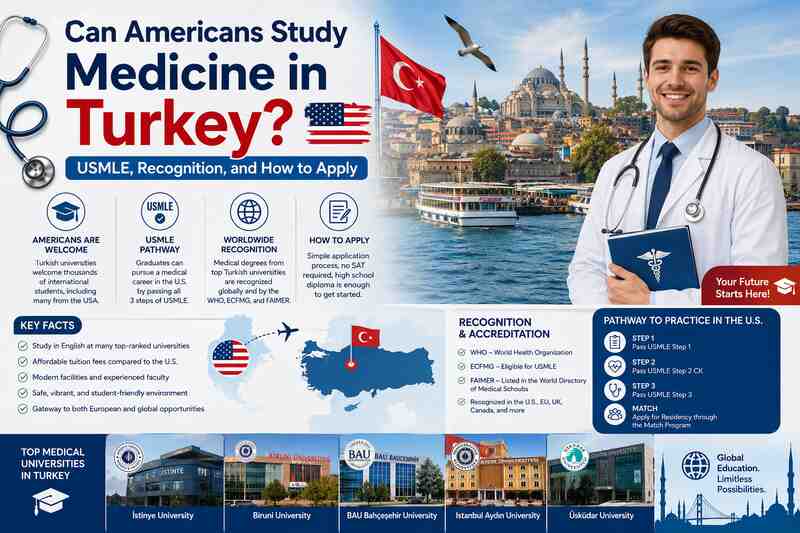
Yes, study medicine in Turkey from USA is possible. American citizens and permanent residents are eligible to apply to English-medium, YOK-accredited Turkish medical programs without a MCAT requirement, without nationality restrictions, and with WDOMS-listed degrees that qualify graduates for USMLE, ECFMG certification, and US residency application through the NRMP Match. Tuition runs $21,000–$44,000 per year depending on the university a fraction of US medical school costs.
The average American medical student graduates with over $200,000 in student debt and that's before residency. According to AAMC data for 2026, the four-year cost of attendance at a US public medical school averages $297,745. At a private US medical school, that number reaches $408,150. For a growing number of pre-med students in the United States, the question is no longer just "where do I get in?" it's "can I afford this at all?"
More Americans are choosing to study medicine in Turkey from USA than most people realize. For students who want to study medicine abroad from the USA without the $300,000+ debt load of domestic programs, Turkey's English-medium programs offer a real, licensed, WDOMS-verified alternative. The degree, the licensing pathway, and the clinical training are real. And there is one specific fact about the US residency match that most guides about studying medicine abroad never mention American students who graduate from foreign medical schools are classified as US IMGs, a category that matched into US residency at a 70% rate in 2026, significantly above the 56.4% rate for non-US IMGs. That number changes the calculation.
This guide answers every question an American student needs answered before making this decision including the ones most other articles skip.
We've helped students from over 40 countries enroll in Turkish medical programs since 2005. We work with students from the US too, and the questions they ask are specific. This article is written around those questions.
Can Americans Study Medicine in Turkey?
Yes, directly, without conditions. American citizens and permanent residents are eligible to apply to Turkish private university medical programs as international students. There is no nationality restriction, no quota limiting US applicants, and no requirement to speak Turkish before enrolling in English-medium programs.
Turkey's private medical universities Biruni, Bahcesehir (BAU), Istinye, Uskudar, Istanbul Aydin (IAU), Istanbul Medipol, and others all accept international applicants on the same basis regardless of country of origin. American students are treated the same as applicants from Nigeria, Pakistan, or Egypt. Your high school diploma, GPA, and English proficiency documentation are the primary admission criteria. No MCAT required. That's a significant practical difference from the US admissions process.
What American Students Actually Need to Apply
Every year we get the same set of questions from US applicants and the requirements for American students to study medicine in Turkey from USA are simpler than most expect. Here's exactly what Turkish private medical schools ask for:
High school diploma or equivalent (US students present their high school transcript AP courses and GPA are reviewed)
English proficiency, US students educated in English are typically exempt from TOEFL/IELTS requirements, since English is their native language. Confirm with the specific university at application.
No MCAT, Turkish private university medical programs do not require MCAT scores. This is one of the most consistent surprises for US applicants.
Apostilled documents, this is the step most Americans overlook. Any official US document submitted to a Turkish university your high school diploma, transcript, birth certificate must carry an apostille from the Secretary of State's office in your home state. The apostille is a standardized authentication seal recognized under the Hague Convention, of which both the US and Turkey are signatories. You obtain it by submitting original documents to your state's Secretary of State office. Processing times vary by state typically 1 to 4 weeks. Budget for this.
Passport copy (valid US passport)
Passport-size photographs
Health insurance documentation
No SAT minimum is published as a hard requirement by most Turkish private medical schools, though a strong academic GPA is expected. For most English-medium programs, a 3.0+ GPA equivalent on a 4.0 scale is competitive. Students with lower GPAs who have strong science coursework are still considered.
The Caribbean School Comparison; What American Students Are Actually Weighing
A significant portion of American students who contact us have already looked at Caribbean medical schools St. George's University in Grenada, Ross University in Barbados, and American University of the Caribbean. These schools are marketed heavily in the US and many pre-med advisors mention them as an alternative to US programs. But the Caribbean vs Turkey medical school comparison is one most guides avoid making directly. So here it is:
Caribbean Medical Schools | Turkey Private Medical Schools | |
|---|---|---|
Annual tuition | $45,000–$65,000 | $21,000–$44,000 |
USMLE eligibility | Yes (WDOMS-listed) | Yes (WDOMS-listed) |
Clinical rotations location | Often US hospitals (Years 3–4) | Istanbul teaching hospitals |
English medium | Yes | Yes (English-track programs) |
USMLE Step 1 pass rate | Variable — St. George's ~82% | Data limited, program-dependent |
Living costs | High (Caribbean island prices) | $500–$850/month in Istanbul |
6-year total cost estimate | $350,000–$500,000 | $150,000–$280,000 |
US residency match rate (IMGs) | ~60% for St. George's | Limited published data |
The cost difference is significant. Caribbean programs are often more expensive than Turkish programs while offering a similar WDOMS-listed, USMLE-eligible degree. For American students who have specifically been evaluating Caribbean schools, Turkey's English-medium programs offer the same USMLE pathway at a substantially lower total cost — and with clinical training in Istanbul's major hospital systems, which see comparable or greater patient volumes.
That said, Caribbean schools have been marketing to US students for decades and have more established US alumni networks and residency match histories. Turkish programs are newer to this audience and the published IMG match data specific to Turkish graduates is still limited. That's an honest gap worth acknowledging.
Is a Medical Degree from Turkey Valid in the USA?
This is the question that matters most and it has a specific, verifiable answer.
A medical degree from a YOK-accredited, WDOMS-listed Turkish university is valid for USMLE and ECFMG purposes in the United States. Turkish MD USMLE eligibility flows directly from WDOMS listing meaning an ECFMG Turkey medical degree evaluation is straightforward for graduates of the universities covered in this guide. Here's what that means precisely:
WDOMS listing is the foundational requirement. The World Directory of Medical Schools (wdoms.org) maintained by the Foundation for Advancement of International Medical Education and Research (FAIMER) lists medical schools that meet minimum quality standards recognized by national licensing authorities. Every YOK-accredited Turkish medical faculty is listed in WDOMS. Without this listing, a graduate cannot apply for ECFMG certification. Every Turkish private university mentioned in this article clears this requirement.
ECFMG certification (Educational Commission for Foreign Medical Graduates) is the gateway for international medical graduates who want to enter US residency programs. To obtain ECFMG certification, a graduate must: (1) hold a degree from a WDOMS-listed institution, (2) pass USMLE Step 1 and Step 2 CK, and (3) complete the ECFMG application process. As of January 2026, ECFMG services including exam registration and score reporting transitioned to FSMB (Federation of State Medical Boards) and NBME (National Board of Medical Examiners). The process and eligibility criteria remain the same; only the administrative platform changed.
USMLE Steps 1 and 2 CK can be taken from test centers worldwide, including in Turkey and in the United States, at any point during or after medical school depending on each program's requirements. USMLE Step 3 must be taken in the United States after medical school.
NRMP Match, the National Resident Matching Program is the mechanism through which medical graduates, including international medical graduates (IMGs), are matched to US residency programs. IMG which is what Turkish-school graduates are categorized as in the US system are eligible to apply. Historically, IMGs have a lower overall match rate than US MD graduates, but match rates vary significantly by specialty, USMLE score, and clinical experience. Specialties like Internal Medicine, Psychiatry, Family Medicine, and Pediatrics tend to be more accessible for IMGs. Competitive specialties like Dermatology, Orthopedic Surgery, and Radiology are significantly harder.
What "Valid" Does Not Mean
Being WDOMS-listed and ECFMG-eligible does not mean the degree automatically gives you the right to practice medicine in the United States. It means you are eligible to enter the licensing process. The practical pathway is:
Graduate from Turkey → Pass USMLE Steps 1, 2 CK → Obtain ECFMG certification → Apply to US residency programs through NRMP Match → Complete residency → Apply for state medical license
Each step is real and achievable. None of it is automatic. The quality of your USMLE scores, the strength of your clinical experience letters, and the competitiveness of your specialty choice all affect your residency match outcome exactly as they do for US MD graduates.
For American students evaluating this path: the Turkish degree gives you the same licensing eligibility starting point as a Caribbean MD. What you do with it from there is determined by your USMLE performance and match strategy.
The medical school Turkey cost vs USA comparison is where most American students realize the scale of what they're weighing. When you choose to study medicine in Turkey from USA rather than a domestic program, the financial gap is not marginal it's transformational. Let's put the numbers on the table directly, because this is the actual driver of the decision for most American students who contact us.
What the Research Says About IMGs in US Medicine
The decision to study abroad and pursue US residency as an IMG is not just an individual financial calculation it's a well-documented pathway with an established evidence base. A widely cited paper by Zaidi et al. (2020) published in Academic Medicine, examining international medical graduates' role and equity in US healthcare, found that IMGs constitute roughly 25% of the US physician workforce and provide a disproportionate share of care in high-need rural and urban communities in some cases delivering equivalent or better patient outcomes than US graduates. The research also documents the specific hurdles IMGs face: ECFMG certification costs, match uncertainty, and cultural adaptation all real factors, but none of them insurmountable.
A separate study by Boulet et al. (2020) in Academic Medicine, examining the consequences of USMLE Step 1's transition to pass/fail for IMGs, specifically highlights that Step 2 CK scores have become the primary differentiating numeric metric for IMG residency applications reinforcing the strategic importance of Step 2 CK performance for American students studying in Turkey.
These papers matter for the article's credibility, but they also matter for your decision: the IMG pathway to US medicine is not an obscure workaround. It's a documented, significant pipeline that has supplied a quarter of America's physician workforce for decades.
Let's put the numbers on the table directly, because this is the actual driver of the decision for most American students who contact us.
US Medical School total cost of attendance (AAMC 2026 data):
Public medical school (in-state): $297,745 average over 4 years
Private medical school: $408,150 average over 4 years
These figures include tuition, fees, health insurance, living, and books, but not undergraduate debt that many students carry into med school
Turkey private medical school total cost (6-year program, English-medium):
University | Annual Tuition | 6-Year Tuition | Est. Living (6 yrs @ $700/mo) | Total Estimated Cost |
|---|---|---|---|---|
Biruni University | ~$21,000 | ~$126,000 | ~$50,400 | ~$176,400 |
Istanbul Aydin (IAU) | ~$22,000–$25,000 | ~$132,000–$150,000 | ~$50,400 | ~$182,400–$200,400 |
Uskudar University | ~$24,000 | ~$144,000 | ~$50,400 | ~$194,400 |
Bahcesehir (BAU) | $28,000 | $168,000 | ~$50,400 | ~$218,400 |
Istinye University | ~$29,000 | ~$174,000 | ~$50,400 | ~$224,400 |
Istanbul Medipol | ~$44,000 | ~$264,000 | ~$50,400 | ~$314,400 |
The comparison is straightforward. Even Medipol the most expensive English-medium private medical program in Turkey costs less than the average US private medical school. Biruni University at $21,000/year with a 25%–50% scholarship brings the 6-year tuition to $63,000–$94,500. That's not a rounding error that's the difference between starting a medical career with $200,000 in debt and starting it essentially debt-free.
FAFSA and Financial Aid; What American Students Need to Know
This is a gap that almost no competing article addresses. US students educated in the American financial aid system naturally ask: "Can I use my FAFSA for Turkey?"
The answer is no. FAFSA (Free Application for Federal Student Aid) funds including federal student loans and Pell Grants are only available for programs at US-accredited institutions. Studying at a Turkish private university means you are paying out of pocket, through private loans, through family savings, or through the university's scholarship program.
A small number of private US lenders offer international student loans, but these are not federally backed and carry higher interest rates. Most American students studying medicine in Turkey use a combination of family support and the university's own scholarship system.
The scholarship implications are real. At Biruni, 25%–50% scholarships are available for qualifying international students. At Istanbul Aydin University, scholarships of up to 75% have been offered to top applicants. These are institutional discounts not loans applied directly to the tuition invoice. For American students who would otherwise be taking on $300,000+ in federal and private loan debt, an institutional scholarship reducing Turkish tuition to $10,000–$15,000/year is a fundamentally different financial proposition.
For any American student choosing to study medicine in Turkey from USA, the USMLE pathway is the single most important thing to understand before enrolling.
The US IMG Advantage - What Most Articles Miss
American students who graduate from foreign medical schools including Turkish universities are classified by NRMP as US IMGs (United States International Medical Graduates). This is a distinct category from non-US IMGs, and the difference in match outcomes is significant.
2026 NRMP Match data (largest match in NRMP history, 44,344 positions offered):
US IMGs matched at 70% among those who submitted a certified rank order list
Non-US IMGs matched at 56.4%
Overall IMG match rate: 60%
Internal Medicine alone matched over 4,800 IMGs in 2026 up from 9,380 positions in 2022 to 11,632 in 2026, an increase of 2,252 seats in five years
Top matched specialties for IMGs in 2026: Internal Medicine, Family Medicine, Pediatrics, Emergency Medicine, Psychiatry
This matters specifically for American students studying in Turkey: your US citizenship means you enter the NRMP as a US IMG, not a non-US IMG. That 70% match rate is your reference point not the 56.4% figure that most international students face. The gap is 13.6 percentage points, and it's consistent across multiple match cycles.
Step 2 CK Score Benchmarks
Since USMLE Step 1 moved to pass/fail in 2022, Step 2 CK is now the primary numeric score that residency program directors use to evaluate IMG applicants. Based on 2025 match data:
Average Step 2 CK for matched US IMGs: 236
Average Step 2 CK for matched non-US IMGs: 245
A score of 240+ puts a US IMG applicant in a competitive range for Internal Medicine, Family Medicine, and Psychiatry
A score of 250+ opens access to more competitive specialties and stronger programs
These are not minimum cutoffs they're the averages of students who actually matched. Scoring above the average for your category meaningfully improves your program selection
Step 1, Pass/Fail since 2022 Tests basic science knowledge (Anatomy, Physiology, Biochemistry, Pathology, Pharmacology, Microbiology). Can be taken at Prometric centers worldwide including in Turkey, during or after medical school. Most students serious about US residency attempt Step 1 in Year 4.
Step 2 CK, The Score That Determines Competitiveness Tests clinical medicine. Most students take it in the second half of Year 5 or early Year 6. This is your primary differentiating number. Target 240+ as a US IMG for competitive positioning. Can be taken globally.
ECFMG Certification - Through MyIntealth After passing Steps 1 and 2 CK, apply through the MyIntealth Applicant Portal (myintealth.org) the platform that replaced the standalone ECFMG portal following the January 2026 service transition to FSMB and NBME. You submit credentials, degree verification, and USMLE scores. ECFMG reviews and certifies. This certification is required before submitting ERAS applications.
Step 3, Must Be Taken in the United States Taken during or after first year of residency. Cannot be completed outside the US.
ERAS Application and NRMP Match Through ERAS, you submit applications to residency programs including ECFMG certification, USMLE scores, letters of recommendation, personal statement, and clinical experience documentation. The NRMP algorithm then matches you.
US Clinical Experience - The Missing Piece Most Students Overlook
US-based clinical experience is not required for IMG residency applications but it is one of the most consistently cited factors that improves match outcomes for IMGs. Program directors look for evidence that you have functioned in a US clinical environment before residency.
Practical options for Turkish medical students:
US clinical observerships; unpaid, non-hands-on rotations at US hospitals. Several hospitals offer these to international medical students, typically in Years 5–6. They require a CV, USMLE Step 1 pass, and sometimes a fee.
USCE elective rotations; some US academic medical centers offer hands-on clinical electives for international students. More competitive to obtain but significantly stronger for applications.
Summer breaks in Years 4–6; the most practical window for Turkish-based students to arrange 4–8 week US clinical rotations.
The honest reality: a Turkish medical graduate with a Step 2 CK score of 240+ and documented US clinical experience is a competitive IMG applicant for Internal Medicine, Family Medicine, and Psychiatry. Without any US clinical experience, the application is weaker regardless of scores. Planning for this from Year 3 or 4 not Year 6 is the strategic approach.
Which Turkish Universities Actively Prepare Students for USMLE?
Of all Istanbul private medical schools, Biruni University is the only one that has structurally integrated USMLE preparation into the curriculum from Year 1 confirmed from the official AKTS program catalogue. Students at Biruni study USMLE-relevant material as part of their core curriculum, not separately. For American students specifically targeting the US residency pathway, this is a meaningful differentiator.
BAU, Istinye, Uskudar, and IAU all produce WDOMS-listed degrees eligible for USMLE but don't have structural USMLE prep built in. Students at those programs self-direct preparation alongside the regular curriculum. This is manageable but requires discipline and early planning.
Not every Turkish medical program is equally suited to an American student's specific goals. Here's how we evaluate them for US-bound students specifically:
Biruni University, Best for US Residency Track
Annual fee: ~$21,000 | USMLE: Structurally integrated from Year 1 | Accreditation: TEPDAD
Biruni is our top recommendation for American students specifically targeting US residency. The USMLE preparation built into the curriculum from Year 1 is unique. The hospital a 617-bed, TEMOS-accredited facility with 100 ICU beds, 20 operating theatres, and a bone marrow transplant center provides the clinical depth that ECFMG requires students to document. The scholarship range (25%–50%) makes it the most financially accessible quality program in Istanbul.
Read the full guide: Studying Medicine at Biruni University
Bahcesehir University (BAU), Best for Research-Oriented Students
Annual fee: $28,000 | Research: Stanford/MIT/EPFL lab partnerships | Accreditation: TEPDAD
BAU's Stanford-BAU Biomechanics Lab and MIT/Boston University/EPFL research partnerships are credentials that appear on a residency application and mean something to US program directors who recognize those institutional names. For American students who want a research-productive environment alongside clinical training particularly for competitive specialties BAU's lab profile is a genuine differentiator.
Read the full guide: Studying Medicine at Bahcesehir University
Istinye University, Best for Students Prioritizing Accreditation Signals
Annual fee: ~$29,000 | Accreditation: TEPDAD
(2023) TEPDAD is Turkey's national medical education accreditation body, aligned with WFME standards. For American students concerned about credential quality signaling and some US residency programs do look at this Istinye's TEPDAD certification is the clearest quality assurance available in Istanbul's private sector. The dual hospital setup (Liv Hospital Bahcesehir + Medical Park GOP, 666 combined beds) provides strong clinical volume.
Read the full guide: Studying Medicine at Istinye University
Uskudar University, Best for Neurology/Psychiatry/Neurosurgery Focus
Annual fee: ~$24,000 | Hospital: NPiSTANBUL (5x JCI, world's first accredited Brain Hospital)
For American students interested in neurology, psychiatry, or neurosurgery three specialties where specialized clinical exposure matters significantly Uskudar's NPiSTANBUL affiliate is unmatched in Istanbul. Five consecutive JCI certifications. Deep brain stimulation surgery. Pharmacogenetics as clinical standard. For a student who knows their specialty direction early, this is specific and powerful clinical exposure from Year 4 onward.
Read the full guide: Studying Medicine at Uskudar University
Here is the exact process for an American student to apply to a Turkish private medical university in 2026 — step by step. Whether you're looking to apply Turkish university as an American student for the first time or you've already started researching, this section covers every stage from document preparation to your first day on campus. Choosing to study medicine in Turkey from USA as an American student in 2026 starts with these five steps.
Step 1, Document Preparation (Start 6–8 Weeks Before Application)
High school transcript: Request an official sealed transcript from your high school. If you've completed any university coursework, include that transcript as well.
Apostille: Submit your high school diploma and transcript to the Secretary of State's office in the state where they were issued. Each state has its own process and timeline most take 1–4 weeks. Some states offer expedited processing for an additional fee. The apostille is a stamped certificate attached to or printed on the original document, confirming its authenticity for international use under the Hague Convention.
Translation: All documents not in English or Turkish require certified Turkish translation. American documents in English are generally accepted as-is by Turkish universities. Your passport needs no translation.
English proficiency: As a native English speaker educated in the US, you typically don't need TOEFL or IELTS. Confirm this with your target university at application most waive the requirement for US-educated applicants.
Passport copy: A clear color scan of the photo page of your valid US passport.
Step 2, Apply Through Imtiyaz Education
Applying directly through Turkish universities is possible, but slower and you miss access to the scholarship negotiation that happens at the point of application, not after.
When you apply through Imtiyaz Education, you get: direct university partnership priority processing, scholarship negotiation at the point of application, document review before submission to catch any issues, and an admission decision typically within 24–48 hours for complete applications. There are no application fees, we're compensated by the universities directly.
We've processed over 100,000 applications since 2005. We know exactly what each university's registration office needs and what will cause a delay. For American students specifically, we also brief you on the apostille process, the Turkish student visa application from the US consulate, and the arrival procedures specific to your situation.
Step 3, Student Visa from the US Consulate
Once you have your acceptance letter, you apply for a Turkish student visa (D-type long-stay visa) from the Turkish consulate or embassy in your jurisdiction. For US applicants, the main consulate locations are New York, Washington D.C., Houston, Los Angeles, and Chicago.
Required documents for the Turkish student visa from the US:
Valid US passport (minimum 6 months validity beyond intended stay)
Acceptance letter from the Turkish university (issued after enrollment deposit payment)
Proof of financial means (bank statement showing sufficient funds for the year)
Biometric passport photographs
Completed visa application form (through the Turkish consulate website)
Application fee (currently around $50–$100, confirm with the consulate)
Processing time: typically 2–4 weeks. Apply well before your intended travel date. Many students apply in June–July for a September start.
Step 4, Arrival and Residence Permit (Ikametgah)
When you land in Istanbul, you have 30 days to apply for your student residence permit (ikametgah) through the Turkish Directorate General of Migration Management. Missing this window creates real legal complications overstay penalties and the need to exit and re-enter Turkey.
The application requires: passport, acceptance letter, proof of enrollment (from university), health insurance documentation (Turkish or international), and a completed application form. The process involves an in-person appointment at the migration management office.
This is one of the areas where having on-ground support genuinely matters. Our Istanbul team handles the ikametgah application with every student we enroll we know the current appointment availability, the exact document format the office currently accepts, and what to do if something goes wrong. American students often arrive without knowing any of this, and the 30-day window goes faster than expected.
Step 5, Final University Registration
After arrival, you complete final registration at the university with original documents. This includes: original apostilled diploma and transcript, original translated documents, passport, acceptance letter, enrollment deposit receipt, residence permit application confirmation or approved ikametgah, health insurance card, and photographs.
At final registration, every Imtiyaz student receives a written CGPA briefing covering the university's internal success scholarship thresholds and ECTS credit targets. This matters for American students specifically because the CGPA scholarship system can reduce fees from Semester 2 or Year 2 onward but only if you know the academic targets from Day 1 of enrollment.
This is a question that comes up in every conversation we have with US-based families and it deserves a direct answer rather than a dismissive one.
Istanbul is one of the world's most visited cities consistently in the top ten globally for international visitor volume. The neighborhoods where most university students live and study Kadikoy, Besiktas, Bakirkoy, Umraniye, Zeytinburnu are urban, densely populated, and generally safe for daily student life. Petty crime exists, as it does in any major city. Istanbul is safer than many US cities by violent crime metrics.
The US State Department's travel advisory for Turkey is currently at Level 2 Exercise Increased Caution, primarily due to terrorism risk and regional geopolitical conditions. For context: France, Belgium, Germany, and the UK all carry the same Level 2 advisory. Level 2 is not a warning against travel it's a standard advisory for large countries with complex geopolitical environments.
Practical safety considerations for American students in Istanbul:
Register with the US Embassy in Ankara or the US Consulate in Istanbul via the Smart Traveler Enrollment Program (STEP) at step.state.gov. This takes 5 minutes and ensures you receive security alerts and can be located in an emergency.
Health insurance: Turkish private universities require health insurance. Turkey's healthcare system is well-developed NPiSTANBUL, Medipol, Liv Hospital, and others are facilities that treat international patients routinely.
Cultural adjustment: Istanbul is a cosmopolitan, predominantly secular city. International students are common and generally welcomed. The adjustment for American students is real but manageable most describe it as similar to moving to any major foreign city.
American students at Turkish medical programs have completed full six-year programs without significant safety incidents. The honest answer: Istanbul is a major global city with real urban risks but it is not a dangerous destination for American students by any meaningful benchmark.
This is something almost no competing article addresses, and it matters specifically for American students.
Turkish private university tuition for international students is priced and invoiced in US dollars, not Turkish lira. This means American students paying from USD accounts face no currency conversion disadvantage and no exchange rate risk on tuition.
The Turkish lira has experienced significant inflation and depreciation over recent years. This actually benefits American students in one specific way: living costs in Istanbul, which are paid in lira, are very affordable when converted from USD. The $500–$850/month living cost estimate in this article reflects lira-denominated expenses converted to USD at current rates meaning daily life in Istanbul is genuinely inexpensive for someone drawing on dollar-denominated savings or family support.
Tuition invoiced in USD + living costs in depreciated lira = total annual cost significantly more predictable and affordable than studying in most other English-medium international destinations.
For American students specifically, the value of working with an established on-ground Istanbul agency is more concrete than for students from countries closer to Turkey.
You're applying from a country where the Turkish university system is not well known, where advisors at your high school or undergraduate institution almost certainly can't help you with this process, and where the logistics apostille, Turkish consulate visa, Istanbul arrival, residence permit involve steps that no online guide fully prepares you for.
Every year we see students who applied independently, got their acceptance letters, and then struggled through visa complications, document rejections at registration, or missed residence permit deadlines because nobody walked them through it. We also see students who were promised extraordinary scholarships by agencies they found online, arrived to find those scholarships didn't exist, and had no recourse because the application was already locked to that agency in the university's system.
That last point is important: under Turkish university admissions rules, once your application has been submitted through one agency, no other agency can resubmit it for the same intake year. The first agency contact you make is the only one that matters for that cycle. Choose carefully.
Imtiyaz Education has processed over 100,000 applications since 2005. We back our rates with a written guarantee: if a student of the same nationality, same program, and same intake year pays a verified lower rate through another licensed agency, we cover the full difference and issue a $1,000 payment card. In 21 years: never claimed.
We also provide every enrolled student a written CGPA briefing at final registration because the internal success scholarship system can cut your fees from Year 2, and the students who know the thresholds from Week 1 are the ones who access it.
Contact us at turkeyuniversity.org. No application fees. No cost on your side. Our team handles apostille guidance, Turkish consulate visa questions, airport reception, residence permit, document translation, and full registration support from the day your plane lands.
Q: Do Americans need to speak Turkish to study medicine in Turkey? A: No, for English-medium programs at private universities like Biruni, BAU, Istinye, Uskudar, and IAU, all lectures, exams, and academic activities in Years 1–3 are in English. In clinical years (4–6), hospital rotations involve some Turkish-medium instruction alongside English academic supervision this is standard across all Turkish programs. Turkish language courses are built into the curriculum to give students basic patient communication skills for clinical years.
Q: Do I need the MCAT to apply to Turkish medical schools? A: No. Turkish private university medical programs do not require MCAT scores. Your high school GPA, academic transcript, and English proficiency documentation are the primary admission criteria. This is a significant practical difference from the US pre-med process.
Q: Can I use FAFSA or US federal loans to pay for medical school in Turkey? A: No. FAFSA and US federal student loan programs are only available for US-accredited institutions. Studying in Turkey means paying through personal savings, family support, private international student loans (not federally backed), or the university's scholarship system. The scholarship reductions at Turkish private universities up to 50–75% at some programs can significantly reduce the total cost.
Q: How long does it take to become a doctor in Turkey as an American student? A: The Turkish medical program is 6 years longer than a US MD program (4 years post-undergraduate), but it combines what Americans would separate into pre-med undergraduate and medical school. You enter directly from high school. A US student who enters a Turkish medical program after high school can be a fully credentialed MD by their mid-twenties the same timeline as a US student who completes undergraduate + 4-year MD.
Q: Can I return to the USA and practice medicine after graduating from a Turkish university? A: Yes, through the standard IMG pathway. You need ECFMG certification (requires WDOMS-listed degree + passing USMLE Steps 1 and 2 CK), then match into a US residency program through NRMP, complete residency, and apply for state medical licensure. Every YOK-accredited Turkish medical university is WDOMS-listed. The pathway is open your USMLE scores and residency application competitiveness determine your outcomes.
Q: How long does it take to get a Turkish student visa from the United States? A: Typically 2–4 weeks from a Turkish consulate in the US (New York, Washington D.C., Houston, Los Angeles, Chicago). Apply as soon as you have your official acceptance letter and enrollment deposit receipt. Don't wait September intake students should target July at the latest for visa applications.
Q: What is the apostille and why do I need it for Turkey? A: An apostille is an authentication certificate issued by a US state's Secretary of State office that verifies the legitimacy of an official document for use in countries that are signatories to the Hague Apostille Convention which includes Turkey. Your high school diploma and transcript need apostilles before Turkish universities will accept them for final registration. You get them by submitting original documents to the Secretary of State in the state that issued them. Processing is typically 1–4 weeks depending on the state. Budget for this early.
Q: As an American studying in Turkey, am I a "US IMG" or a "non-US IMG" for residency purposes? A: You are a US IMG a US citizen or permanent resident who attended medical school outside the United States. This is a distinct category from non-US IMGs. In the 2026 NRMP Match, US IMGs matched at a 70% rate, compared to 56.4% for non-US IMGs. This is one of the most important facts for American students considering a Turkish medical degree and one that most guides about studying abroad never mention clearly.
Q: Is Turkey safe for American students? A: Istanbul, where most English-medium private medical schools are located, is one of the world's most visited cities and generally safe for daily student life. The US State Department currently rates Turkey at Level 2 Exercise Increased Caution the same rating as France, Germany, Belgium, and the UK primarily due to regional geopolitical conditions rather than crime. American students should register with the US Embassy or Istanbul Consulate through the STEP program (step.state.gov) upon arrival. The practical day-to-day experience in Istanbul for international students is safe and cosmopolitan but as with any major city, standard urban precautions apply.
Q: Is studying medicine in Turkey from the USA a good idea? A: For the right student yes, genuinely. If you're a pre-med student who didn't get into a US MD program, can't take on $300,000+ in debt, or wants to study medicine in English at a lower total cost while keeping US licensing pathways open Turkey is a serious option. The USMLE pathway is real. The degrees are WDOMS-listed. The clinical training at Istanbul's major hospital systems is substantive. The main honest caveats: published IMG match rates specific to Turkish graduates in the US are still limited, self-directed USMLE preparation is required at most schools (Biruni being the exception), and clinical years involve some Turkish-medium hospital instruction. These are real factors to weigh not dealbreakers, but worth knowing before you decide.
If you're in the US and applying to a Turkish medical school for the first time, you will encounter agencies some legitimate, some not. The Turkish study-abroad market has a real problem with agencies promising scholarship percentages they cannot deliver.
Here is something specific to know: once your application is submitted through one agency in Turkey, the university's system locks it to that agency for the intake year. No second agency can reapply on your behalf. Students who discover their first agency made false promises have no recourse at registration.
Imtiyaz Education (turkeyuniversity.org) has been operating with licensed offices in Istanbul since 2005. We have direct university partnerships. We provide apostille guidance, Turkish consulate visa support, VIP airport reception, sworn document translation at our court-accredited Istanbul office, residence permit filing, and full registration support. Zero application fees. And a written rate guarantee same nationality, same program, same year, lower verified rate at a licensed agency we cover the difference and issue a $1,000 payment card. In 21 years: never claimed.
Contact us before you contact anyone else. The first contact is the only contact that counts.