Medical Education in Turkiye: A Detailed Guide for International Students 2026

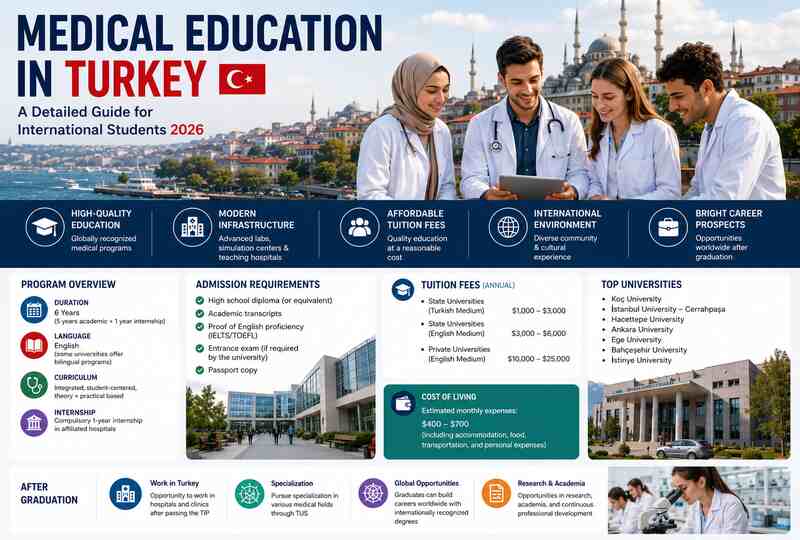
If you are looking at a medical degree in Turkiye for 2026, you are eyeing one of the fastest-growing medical hubs in the world. This isn't just about finding a cheaper degree; it is about accessing high-tech hospitals and a curriculum that actually meets European standards. The big question most students ask is: is Turkey good for medical studies 2026? Well, when you combine modern labs with a massive volume of clinical cases, the answer becomes obvious. Turkey offers a medical education that prepares you for the global market, period.
One of the best parts? You can medical degree in Turkiye in English. This opens doors for international students who want to skip the language prep year and get straight to work. As a med student in Turkey, your classroom isn't just four walls it is the university hospital. Since Turkey is a massive destination for medical tourism, you get to see complex cases firsthand. This kind of practical exposure is why Turkish medical education is gaining so much respect lately.
Let's break down the finances. How much does it cost to get a medical degree in Turkiye?
The medical degree in Turkiye fees are the biggest draw. You get world-class facilities at private universities for a fraction of the price you'd see in the UK or the US. Whether you want the best private medical universities in Turkey or you are looking for specific requirements to study medical specialties for international students, the value for money here is tough to beat.
So, how many years is medical school in Turkey? It is a 6-year grind, taking you from basic anatomy to a full clinical internship. By the time you graduate, you’ll have a degree that works for you, whether you plan on practicing medicine in Turkey or heading back home. This guide is your 2026 roadmap no fluff, just the facts you need to start your medical career in Turkey.
If you are asking is medical degree in Turkiye good, the answer for 2026 is a definite yes. Turkish universities have moved far beyond traditional teaching, undergoing a massive digital and physical transformation. By aligning with the ECTS (European Credit Transfer and Accumulation System), these institutions ensure that your hard work is recognized globally. But what actually makes studying medicine in Turkey stand out for the 2026 intake?
Global Recognition and the Blue Diploma
The most important thing for any international student is where their degree can take them. Most medical schools in Turkey for international students are listed in the World Directory of Medical Schools.
The Blue Diploma: Upon graduation, you receive the European Diploma Supplement. This is your "passport" to Europe, making it much easier to pursue residency or clinical training and the EU.
International Pathways: Whether you are aiming for the USMLE (via ECFMG) or looking at European hospitals, a Turkish medical degree keeps those doors wide open.
Advanced Clinical Exposure and "Health Cities"
Being a med student in Turkey means you aren't just stuck behind a desk. The "University Hospital" model used here is all about practical, hands-on learning.
High-Tech Facilities: You will likely train in "Health Cities" or advanced complexes like Koç University Hospital or Medipol Mega. These places often house better robotic surgery tools and diagnostic tech than many hospitals in Western Europe.
Medical Tourism Hub: Turkey is a global leader in medical tourism. For you, this means seeing a massive variety of complex clinical cases that you simply won't find in smaller, less busy countries.
Early Interaction: medical education in Turkiye for international students is designed to get you in front of real patients early, building clinical confidence from the start.
A Welcoming Environment for Future Doctors
Beyond the labs and clinics, the lifestyle matters. Turkey acts as a cultural bridge, making it very easy for students from all over the world to feel at home.
Modern Infrastructure: 2026 sees the full operation of new medical campuses designed specifically for international research.
Busy Clinical Edge: Because the hospitals are so active, you learn to handle the pressure of modern medicine much faster.
In short, choosing turkey medical education is a smart investment. You get a world-class degree, training in some of the world's busiest hospitals, and a lifestyle that supports your growth as a doctor.
If you are planning your application, the first thing you need to wrap your head around is the timeline. A very common question is: how many years is medical school in Turkey? Unlike the US or Canada, where you need a prior degree, Turkey offers an integrated "long-cycle" program. This means you enter right after high school and stay for 6 intensive years.
Here is exactly what those six years look like for a medical student in Turkey:
Phase 1: The Pre-clinical Years (1–3): This is where you build your foundation. You’ll spend most of your time in labs and lecture halls focusing on the "hard sciences" think anatomy, physiology, and biochemistry. It’s the toughest part for many, but it’s what prepares you for the hospital floor.
Phase 2: Clinical Clerkships (4–5): This is where things get real. You move out of the classroom and into the university hospitals for rotations. You’ll spend weeks at a time in different departments like General Surgery, Pediatrics, and Internal Medicine, learning how to actually diagnose and treat patients.
Phase 3: The Internship Year (Year 6): In your final year, you are no longer just a student; you are a "candidate doctor." Turkey medical students in their 6th year take on actual responsibilities in patient care under the watchful eye of professors. In many cases, you even receive a monthly stipend during this year as you work full-time in the wards.
How to study medical program in Turkiye as an international student in 2026 also requires knowing the entry gates. Most universities will look at your high school GPA, but many also require the TR-YÖS exam. If you want to skip the language year, you should aim for medical schools in Turkey for international students that offer 100% English programs.
By the time you finish this 6-year journey, you won’t just have a degree—you’ll have thousands of hours of clinical experience under your belt. It’s a long road, but it’s exactly why turkey medical education is so highly regarded globally.
So, you’re looking for the best university to study medical degree in turkiye for 2026? Honestly, the "best" one depends entirely on your budget and where you see yourself working later. Turkey is packed with options, from old-school prestigious state universities to flashy, high-tech private campuses.
The State Heavyweights (Public Universities)
If you’ve got the grades and want that "prestige" factor, these are the ones to beat. Just a heads-up: they are incredibly competitive.
- Hacettepe University (Ankara): Ask anyone, and they’ll tell you this is arguably the best university to study medical program in turkiye It’s an academic beast. If you want a top-tier research background and can handle the pressure, this is your spot.
- Istanbul University-Cerrahpaşa: This place is legendary. It’s huge, it’s historic, and the patient volume is off the charts. As a med student in Turkey here, you’ll see everything literally everything which is the best way to actually learn medicine.
- Ankara University: These guys are pioneers. They’ve been doing clinical training right for decades and are known for solid research.
Top Private Schools (Modern & International-Friendly)
For most international students, the best medical schools in Turkey for international students are in the private sector. Why? Because they actually want you there and make the admission process way smoother.
- Koç University: If you want that elite, world-class vibe, Koç is the winner. It’s tough to get into, but the Turkey medical education you get here is as good as it gets. Perfect for future researchers.
- Istanbul Medipol University: This is the practical choice. They have a massive hospital network across Europe. You get your hands dirty with unparalleled hands-on training from year one, which is exactly what you need.
- Bahçeşehir University (BAU): This is the go-to for anyone who wants to study medical major in English. They have a "Global Campus" thing going on, meaning you can do rotations in the US or Europe. Very international vibe.
- Istanbul Aydın University: Their Florya medical campus is super modern. They focus heavily on the practical side of how is medical schools in Turkey, so you’ll spend a lot of time in the clinics.
The Bottom Line
When picking your university for 2026, don’t just look at rankings. Think about the language can you study medicine in English Turkey, or are you ready for Turkish? Also, check if they have their own hospital (like Medipol). At the end of the day, whether you go public or private, the clinical exposure you get in Turkey is leagues ahead of most other countries. It's a solid start for anyone serious about practicing medicine in Turkey or going back home.
Let’s get into the practical side of things. If you want to study medicine in Turkey, your paperwork needs to be spotless. I’ve seen many students miss out just because they forgot a simple translation or a stamp. To avoid that headache, here is exactly what you need to have in your folder:
● Your High School Diploma: This is the big one. Whether you are applying to private or public schools, they’ll want to see your original diploma. If you haven't graduated yet, a "testamur" or official letter from your school works for the initial application.
● Transcripts (The last 3 years): Don't just bring your final year. Turkish universities want to see your "track record," especially in Science and Math.
● A Valid Passport: Double-check the expiry date! It should be valid for at least six months to a year from the day you plan to land in Turkey.
● Language Proof: If you are planning to study medicine in Turkey in English, you’ll need a TOEFL score. No TOEFL? No problem—most universities will just have you sit for their own English proficiency exam when you arrive.
● Biometric Photos: You’ll need a handful of these for your student ID and residency permit.
A quick heads-up: if you are eyeing a spot in a public school to keep your study medicine in Turkey fees low, the TR-YÖS result is basically your most important "paper." On the flip side, private universities are usually okay with just your high school grades and maybe a short interview.
Just remember to get everything translated into Turkish or English and officially notarized. It’s an extra step, but it’s the only way to make your application "official" in the eyes of the admissions office.
For most international applicants, the biggest concern isn't the biology or the chemistry—it’s the language barrier. Fortunately, the ability to study medical university in Turkey in English has been a total game-changer for the 2026 intake. While Turkish is the national language, the higher education system has adapted to welcome the world.
• The English-Medium Advantage
Many of the top-tier medical schools in Turkey for international students now offer programs that are 100% in English. This means:
• No Language Gap Year: You can dive straight into your medical degree without spending a full year in a Turkish prep school.
• Global Standard Textbooks: You will be using the same international medical resources and journals used in the US and UK.
• Easier Transition for Exams: If you plan on taking the USMLE or PLAB later, studying the terminology in English from day one is a massive advantage.
The "Clinical Reality" of Turkish
Even if you choose to study medicine in English Turkey, there is one practical detail you need to know: the patients.
• Pre-clinical Years (1-3): Everything is in English—the lectures, the exams, and the lab work.
• Clinical Years (4-6): While your professors and exams remain in English, you will be interacting with local patients in university hospitals.
• The Hybrid Benefit: Most universities provide free or integrated Turkish language classes. By the time you reach the 4th year, you’ll have enough basic Turkish to take a patient's history, which actually makes you a more versatile, bilingual doctor.
How to Choose the Right Program?
When searching for medical schools in Turkey for international students, always check the "Instruction Language" on the university’s official portal. While many private universities (like Koç, Medipol, or BAU) are famous for their English programs, some state universities offer them too—though they are much more competitive.
In short, choosing to study medical degree in Turkiye in English gives you the best of both worlds: a world-class education in a global language, and the clinical edge of working in one of the world's most diverse medical markets.
If you’re trying to balance your budget, you need to see the numbers side-by-side. Usually, studying in English is the "premium" option, while the Turkish programs are a bit easier on the pocket. Here is the breakdown for the most popular private medical schools in Turkey:
University Name | Tuition (English Program) | Tuition (Turkish Program) |
Koç University | $44,000 | (English Only) |
Yeditepe University | $32,500 | $27,500 |
Istanbul Medipol University | $28,000 | $22,000 |
Bahçeşehir University (BAU) | $25,000 | $25,000 |
Atılım University | $21,000 | (English Only) |
Istinye University | $19,440 | $15,120 |
Altınbaş University | $19,000 | $15,000 |
Istanbul Aydın University | $17,500 | $17,500 |
Üsküdar University | $15,000 | $12,000 |
A Few "Human" Tips on the Pricing:
The "English Premium": As you can see, choosing the English track usually adds a couple of thousand dollars to the bill. But if you're planning to take the USMLE or work in Europe, it’s a smart investment because you won't have to spend a year in a language prep school (TÖMER).
Hidden Costs: Always keep a bit of extra cash (around $500 - $1,000) for things like residency permits, health insurance, and those massive medical textbooks that weigh a ton.
Scholarships: Don't just look at the "sticker price." Many of these universities offer partial scholarships if you apply early or have a really high high-school GPA.
The Bottom Line on Costs
Even at $25,000 a year, you’re still paying less than half of what a private med school in the US would charge. It’s about getting that "high-tech" training without having to pay for it for the next 40 years of your life.
Why Pay More? Get Professional Help for Free
Here is the real "insider tip": the paperwork for studying abroad can be a total nightmare, but you don't have to pay someone to fix it. When you apply through us, the entire application process is 100% free.
We don't just get you the seat; we handle the stressful stuff like your student visa and residency permit (Ikamet) at no extra cost. We’ve already helped thousands of students start their medical journey in Turkey you can check out the exact numbers and our full story on our About Us page. Let us handle the boring bureaucracy so you can focus on your studies.
Let’s cut to the chase. If you’re worried about whether a Turkish medical degree "counts" back home or in the West, you’re looking for two things: Rankings and Accreditations. In Turkey, you’ve got two different worlds the massive, old-school state universities and the high-speed, high-tech private ones. Both are heavy hitters, but for different reasons.
The Academic Giants (Public)
Names like Hacettepe and Istanbul University-Cerrahpaşa aren't just local favorites. They are research monsters. You’ll find them consistently in the top 500 of the QS World University Rankings. These places have been teaching doctors for decades, and their clinical experience is just... massive. They might not have the fanciest cafeterias, but their medical legacy is world-class.
The Tech-Driven Private Schools
Then you have the "new money" schools—Koç, Medipol, and Bahçeşehir (BAU). Koç is basically the "Ivy League" of Turkey, sitting right at the top of the global charts. These private universities are climbing the Times Higher Education lists fast because they have the "toys." We're talking robotic surgery, genetics labs that look like they're from the future, and massive budgets. If you want a degree that feels modern and "global," this is it.
The "Golden Ticket": TEPDAD & WFME
This is the part you can't ignore. Most top-tier schools here private or public are accredited by TEPDAD. Why does that matter? Because TEPDAD is recognized by the WFME.
The Big Win: This is your bridge to the USA. If you want to take the USMLE, your school must have this recognition.
Europe Ready: Most graduates get the "Blue Diploma" (Diploma Supplement), which is basically a green light for hospitals across the EU to recognize your 6 years of hard work.
The Verdict
So, is it worth it? Look, when you combine these high rankings with the clinical exposure you get in Turkey's "Health Cities," it’s a no-brainer. You're getting a degree that opens doors in New York, London, or Berlin without the soul-crushing debt. It’s a solid investment, plain and simple.
Many students find themselves falling in love with the country during their 6-year journey and start wondering: is practicing medicine in Turkey actually possible for foreigners? The short answer is yes, but you need to understand the legal and academic roadmap. Turkey has opened its doors to international doctors, but because the Turkey medical education standards are so high, the transition involves a few mandatory steps to ensure you are ready for the local healthcare system.
The Specialization Path (TUS Exam)
If your goal is to become a specialist—like a surgeon or a cardiologist—the most common route is the TUS (Medical Specialization Education Entrance Exam). This is a rigorous exam taken by both locals and foreigners. As a medical student in Turkey, you’ll spend your final years hearing about the TUS constantly. It is the gatekeeper to residency programs in both state and private hospitals. If you pass, you can start your specialization training, which typically lasts between 3 to 5 years depending on the field.
The STS and Equivalency (For External Degrees)
While those who graduate from a medical school in Turkey have a smoother path, any doctor coming from abroad must pass the STS (Level Detection Exam) to prove their medical knowledge aligns with Turkish standards. Once you pass the STS and complete the clinical rotations (if required by the Higher Education Council - YÖK), your degree becomes fully recognized for work within the country.
Mandatory Service and Work Permits
One thing to keep in mind is that graduates from state universities may have a "Mandatory State Service" (Zorunlu Hizmet) requirement, though this often applies differently to foreigners depending on their residency status. To work in private hospitals, you will need a formal work permit from the Ministry of Health.
If you're looking for a world-class medical degree that doesn't come with a lifetime of debt, Turkey is probably already on your radar. From high-tech hospitals to degrees that actually open doors globally, here is everything you need to know before you apply.
1. Does a Turkish medical degree actually count globally?
The short answer is yes. This is the biggest reason students flock here. Most schools are part of the World Directory of Medical Schools and follow the Bologna Process, which syncs your degree with European standards. If you’re eyeing the USA, just check for the ECFMG sponsor note—most top-tier schools have it, meaning you’re clear to take the USMLE.
2. Can I really study in English?
Absolutely. You don’t have to spend a year struggling with a new language before you even start your first anatomy class. There are plenty of English-taught programs in both public and private sectors. Just a heads-up: while your textbooks are in English, you’ll pick up some basic Turkish during your hospital years so you can actually talk to your patients. It’s part of the experience!
3. Let’s talk money: What’s the yearly cost?
It varies quite a bit. Public universities are a steal, usually costing between $3,000 and $12,000 a year but they are super competitive. Private universities, which are more accessible, generally range from $15,000 to $44,000. Even at the high end, it’s still a massive discount compared to the eye-watering tuition in the UK or the US.
4. What do I need to get in?
For most private schools, they’ll look at your high school GPA and your English level (like IELTS or TOEFL). Public schools are a bit tougher; they usually want to see a strong score on the TR-YÖS exam. Either way, having solid grades in science subjects is your best bet.
5. How long is the journey?
It’s a 6-year marathon. The first three years are all about the books and theory. By year 4 and 5, you’re finally in the hospital doing clinical rotations. The 6th year is your "Internship," where you’re basically working as a doctor-in-training. It’s intense, but it’s how you get "job-ready."
The Verdict for 2026:
If you're still asking yourself, "Is it worth it?"—just look at the tech in these hospitals. Turkey has become a global hub for medical training for a reason. It’s a smart, high-value move for your career. Just don’t wait too long; those application deadlines sneak up fast!