Turkey Student Visa Rejected: What Happens Next and How We Protect Your Tuition

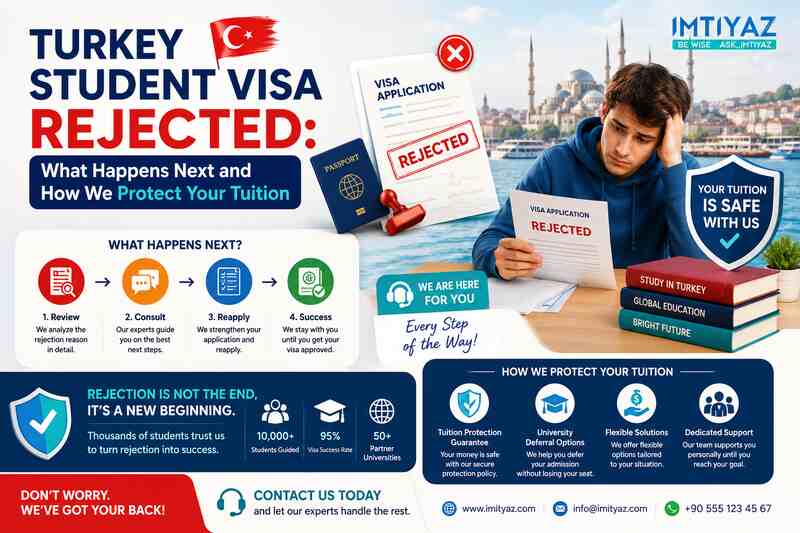
A Turkey student visa rejection is one of the most stressful things that can happen after a student has already chosen a university, paid a deposit, and made plans to move. We've seen it happen not often, but enough that we built specific protections around it, and enough that we want to give you an honest picture of what it actually means and what your options are.
The first thing to know: a visa rejection is not the end of the road. In most cases it's either reversible or replaceable with a reapplication. The second thing to know is that how you applied and who you applied through determines whether you lose money or lose nothing when it happens.
Over 21 years and more than 100,000 processed applications, our team at turkeyuniversity.org has handled every type of visa complication. This guide covers the real reasons Turkey student visas get rejected, what happens to your university place and tuition, how to reapply effectively, and the one protection that no student applying through us ever goes without.
Why Turkey Student Visas Get Rejected: The Real Reasons
Turkish student visa applications are reviewed by the embassy or consulate of the student's home country. The decision is made by Turkish consular staff, and the criteria are not always communicated clearly. But based on years of experience supporting students through the process, we've seen the same patterns repeat.
Incomplete or inconsistent documentation. This is the most common reason. A name that appears differently on the passport versus the acceptance letter. A bank statement that doesn't cover the dates stated in the application. A health insurance policy that expires before the academic year ends. Consular officers look for internal consistency when documents don't match, the file gets rejected. This is entirely avoidable with proper preparation, which is why we review every document before it leaves the student's hands.
Insufficient proof of financial means. Embassies want to see that the student can cover tuition plus living costs for the year. Some embassies specify a minimum amount; others make a judgment call. A bank statement showing a large deposit made two days before the application is a red flag. Statements showing sustained balance over 1–3 months are far stronger. Students who aren't sure what amount to show should ask us before submitting not after.
Weak ties to home country. Consular officers assess whether the student intends to return home after studies or overstay their visa. Students with no evident family ties, property, or career plans at home sometimes face more scrutiny. A well-organized file that includes family documents, a letter explaining career intentions, or evidence of property ownership helps considerably.
Acceptance letter problems. An acceptance letter that doesn't include all required information full name, program, start date, duration, official stamp and signature creates problems at the embassy. We review every acceptance letter before handing it to the student because we've seen universities issue incomplete letters that caused avoidable rejections.
Missing visa support documentation. A basic acceptance letter from the university is the minimum. It's not always enough. Every student who applies through us receives two visa support documents: a university-specific letter written for their individual application, plus our own agency authentication document confirming the application has been professionally handled and will be followed through to enrollment. This dual documentation gives the visa file a level of substantiation that solo applicants simply don't have.
What Happens to Your University Place When Your Visa Is Rejected?
This is the question that causes the most anxiety and the answer depends entirely on how you applied.
If you applied directly through the university: Most Turkish private universities have a general policy of considering tuition deposits non-refundable or only partially refundable. Some will grant an extension to the next intake. Some will refund under specific conditions. But the terms vary by university, they're often vague, and they're not written into the offer letter in a way that protects you legally. If a direct applicant's visa is rejected, they are largely at the university's discretion.
If you applied through turkeyuniversity.org: Every student we enroll receives a university offer letter that includes a formal tuition refund clause for visa rejection written directly in the letter, on university letterhead, as a legal document clause. This is not a promise on our website. It's not a verbal assurance from an admissions officer. It is a contractual clause in the document that governs your enrollment. Sample offer letters are published as PDFs on our website read it before you apply.
This clause means: if your visa is rejected, your tuition payment is refunded. No loss. No dispute. No chasing the university. The protection is in writing before you pay anything.
No other agency in Turkey offers this protection at the offer letter stage. It exists because we negotiated it with our partner universities over 21 years of institutional relationships and because we believe no student should face financial loss because of an embassy decision.
Read more at: Why Choose Imtiyaz Education for Your Turkish University Application - Best Study Abroad Agency in Turkey.
Can You Reapply After a Turkey Student Visa Rejection?
Yes, and in most cases, you should. A single rejection does not permanently close the door. But how you reapply matters significantly.
Step 1; Understand exactly why the visa was rejected. Turkish embassies are sometimes vague about rejection reasons, but you can usually identify the most likely cause by reviewing your file. Was the financial proof thin? Was there a document inconsistency? Was the acceptance letter incomplete? Each of these has a specific fix.
Step 2; Strengthen the weak elements. If the financial proof was the issue: provide a stronger bank statement covering a longer period, add a sponsor letter with supporting documentation, or provide evidence of a scholarship or tuition advance payment. If document consistency was the issue: get corrected documents, retranslate if needed, and verify names match exactly across all files. If the acceptance letter was incomplete: request a revised, detailed letter from the university's international office.
Step 3; Add supporting documentation. For a reapplication, include everything from the original file plus additional supporting materials family documents, employment or enrollment records from home, property evidence, or a personal statement explaining the purpose and plan of study. Our team prepares reapplication files specifically because we know what the embassy needs to see the second time.
Step 4; Consider the timing. If the rejection occurred close to the academic start date, a reapplication might not be processed in time for the same intake. In this case, we work with the university to defer enrollment to the next intake typically the following semester — so the student's place and any financial arrangements are maintained.
Step 5; Apply with proper support. A reapplication file should be stronger than the original. Students who reapply alone, submitting the same documentation that got rejected the first time, typically face the same result. Students who reapply with a restructured file and professional agency support have a substantially higher success rate.
One thing that catches students off guard is how long visa processing actually takes in different countries. These are realistic estimates based on our experience handling applications from different source countries:
Country | Typical Processing Time | Common Issues |
|---|---|---|
Nigeria | 3–6 weeks | Financial proof scrutiny, accommodation documentation |
Pakistan | 2–4 weeks | Document translation quality, financial consistency |
Egypt | 2–4 weeks | Generally smooth if file is complete |
Indonesia | 3–5 weeks | Health insurance documentation |
Bangladesh | 3–6 weeks | Financial ties to home country documentation |
Morocco | 2–3 weeks | Generally smooth |
Sudan | 4–8 weeks | Additional scrutiny, allow more time |
Jordan | 2–3 weeks | Generally smooth |
Iraq | 4–8 weeks | Allow extra time, file needs to be very complete |
Ghana | 3–5 weeks | Financial proof |
These are estimates from our experience — not official embassy timelines. Always book travel and accommodation with some flexibility until the visa is confirmed. Students who book non-refundable flights before their visa is issued are taking an unnecessary risk.
When a student applies through turkeyuniversity.org, visa support is not an afterthought it's a core part of what we deliver.
We prepare the complete visa file, not just the acceptance letter. We review every document for consistency. We issue our own authentication document alongside the university letter. We brief the student on what to say and bring to their embassy appointment. And every offer letter we issue includes the tuition refund clause — so if the visa is still rejected despite everything, no money is lost.
After the student arrives, our on-ground team meets them at the airport and handles the next stage: the residence permit (ikametgah) application, which must be submitted within 30 days of arrival. All documents for the residence permit tax ID, health insurance, accommodation contract notarization are handled at our office. Students from 170+ countries have gone through this process with us. We know what's needed, country by country, document by document.
If you're planning to apply to study in Turkey and want to make sure your visa file is complete, consistent, and protected from the start apply through turkeyuniversity.org. Zero application fees. The refund clause in your offer letter. And a team that handles the process from your first inquiry to your first day of class.
Prevention is better than reapplication. These are the documents that, when properly prepared, give a Turkey student visa application its best chance of approval:
Acceptance letter, complete and specific. Must include: full legal name exactly as in the passport, program name, academic year, start and end dates, tuition amount, and the university's official stamp and authorized signature. Generic acceptance letters without these details cause problems.
Financial proof, sustained and documented. A bank statement showing consistent balance over at least 30–60 days. If a large transfer was recently made, include the remittance record showing its origin. If a sponsor is funding the studies, include a sponsor letter plus the sponsor's statement and ID.
Health insurance, valid and comprehensive. Must be valid in Turkey, cover the full duration of the visa period, include hospitalization and emergency coverage. Most universities offer group insurance plans that we coordinate for our students.
Accommodation proof. A dormitory reservation letter from the university, a signed rental agreement, or a host letter with supporting ID.
Agency authentication document. Our own document confirming the student's application has been accepted and is being professionally managed through enrollment. This is issued by us alongside the university support letter and is fully authenticated for use in the visa file.
Visa support letter from the university. Not a generic template a specific letter written for the student's individual application, referencing their name, program, and enrollment details.
Q: What is the most common reason Turkey student visa applications are rejected? A: Incomplete or inconsistent documentation is the leading cause — a name mismatch between the passport and acceptance letter, insufficient financial proof, or an acceptance letter that doesn't include all required details. The second most common cause is insufficient financial means documentation, specifically bank statements that are too recent or show inconsistent balances. Proper file preparation before submission eliminates both of these risks.
Q: Can I get my money back if my Turkey student visa is rejected? A: It depends on how you applied. Students who apply through turkeyuniversity.org receive a university offer letter that includes a written tuition refund clause for visa rejection — it's in the offer letter itself, not just a verbal promise. Students who apply directly to the university are generally subject to the university's own refund policy, which is often vague and not always favorable. The refund clause is one of the most important reasons to apply through an authorized agency.
Q: How long should I wait before reapplying after a Turkey student visa rejection? A: There's no mandatory waiting period, but reapplying immediately with the same documents that got rejected is unlikely to produce a different result. Take time to identify the rejection cause, strengthen the weak elements in your file, and add supporting documentation. Most students who reapply with a properly restructured file are successful. Our team supports reapplication preparation specifically.
Q: Will a visa rejection affect my next application? A: A previous rejection can be flagged in your file and may lead to additional scrutiny in future applications. It's not a permanent bar — students are approved after previous rejections regularly. But it does mean the reapplication file needs to be stronger and more thoroughly documented than the original.
Q: What happens to my university place if I reapply and miss the intake? A: We work with our partner universities to defer enrollment to the next available intake — typically the following semester — so the student's place is maintained. This is handled through our direct institutional relationships. Students who applied through us don't need to start the admissions process over; the place is preserved pending the successful visa reapplication.
Q: Is the Turkey student visa refusal rate high? A: Turkey's student visa refusal rate is generally lower than for tourist visas, particularly for students with complete documentation and genuine enrollment at an accredited university. Among students whose files we prepare, the rejection rate is very low — because we catch the issues before submission rather than after. The students who face the most difficulty are those who submit incomplete or inconsistent files without professional preparation.
Every visa rejection we've helped students through has had one thing in common: it was either preventable, reversible, or financially protected. The prevention comes from proper preparation. The financial protection comes from the refund clause in the offer letter. And the reversal — when needed — comes from knowing exactly how to rebuild the file and what the embassy needs to see the second time.
Apply through turkeyuniversity.org. Zero application fees. The refund clause in your offer letter before you pay anything.