Study in Turkey vs Malaysia 2026: Which Country Is Right for You?

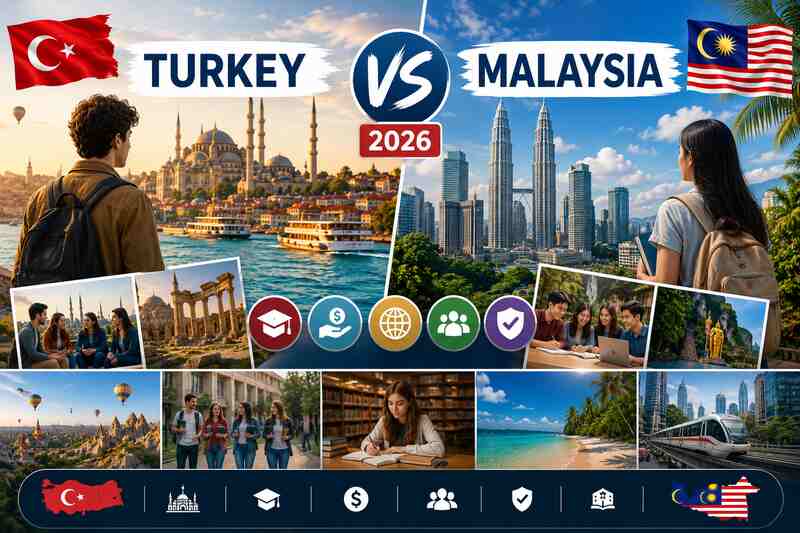
Every year, the same question lands in our inbox at Imtiyaz Education dozens of times: "We're deciding between Turkey and Malaysia which one do you recommend?"
It's a fair question, and one that deserves a real answer. Both countries have invested heavily in becoming international education hubs. Both offer English-taught programs, affordable tuition compared to Western universities, and growing global recognition. And both have genuine strengths. But the differences between them in cost, accreditation systems, degree recognition, visa process, cultural environment, and post-graduation options are significant enough that the right choice genuinely depends on who you are and what you're studying.
This article is a full comparison of study in Turkey vs Malaysia for the 2026-2027 academic year. We're covering the factors that actually matter to international students making this decision: tuition, living costs, accreditation, admission difficulty, scholarship access, the student experience, and what happens after graduation. The goal isn't to declare a winner it's to give you a framework for deciding which destination fits your specific situation.
At Imtiyaz Education, we've been placing international students in Turkish universities since 2005. We don't operate in Malaysia, so we have no commercial stake in pushing Turkey over Malaysia. What we do have is 21 years of experience watching students make this decision, and we've seen the patterns that predict satisfaction and regret on both sides.
Why Students Choose Between Turkey and Malaysia
Both Turkey and Malaysia emerged as serious study destinations in the late 2000s, driven by deliberate government strategy. Malaysia launched its Education Hub initiative to position the country as the regional leader for Southeast Asian and Middle Eastern students. Turkey launched Türkiye Scholarships (YTB) and expanded private university capacity dramatically to attract students from Central Asia, Africa, and the Arab world.
The overlap in their target markets explains why so many students end up comparing them directly. Both countries pitch themselves at the same profile: a student from a developing country who wants a recognized international degree in English, at a cost significantly below Western alternatives, in a Muslim-majority or Muslim-friendly environment.
Research consistently shows that cost, institutional reputation, and safety are the top pull factors when international students choose non-traditional destinations. A 2022 study by Ke et al. published in Frontiers in Psychology found that university attractiveness factors particularly reputation and program quality outweigh national-level factors in student destination decisions, with cost remaining a key secondary driver (Ke et al., 2022, doi: https://consensus.app/papers/details/460254049ae55f90b521e395eee819d3/). This means you shouldn't choose Turkey or Malaysia based on generalities about the countries you should be comparing the specific universities and programs you're actually considering.
Still, country-level factors set the context. Let's go through them.
Tuition Fees: Turkey vs Malaysia
Turkey, private university tuition for international students (2026-2027):
Most undergraduate programs at Turkish private universities range from $3,000 to $12,000 per year. The spread is wide because Turkey has roughly 75+ private universities with significant variation in prestige and tuition pricing.
General bachelor's programs (business, law, social sciences): $3,000 - $7,000/year
Engineering programs (with MÜDEK accreditation): $4,000 - $10,000/year
Medicine (MD, 6 years): $8,000 - $20,000/year depending on university and language
Dentistry: $7,000 - $15,000/year
Pharmacy: $5,000 - $10,000/year
State (public) universities in Turkey charge significantly less sometimes under $1,500/year but require TR-YÖS exam scores or equivalent for international students and offer fewer English-taught programs.
A merit scholarship of 25-50% is commonly available through private universities for students with strong academic records. Students applying through Imtiyaz Education are assessed for scholarship eligibility at the time of application.
Malaysia, private university tuition for international students (2026):
Malaysia's tuition ranges are broadly comparable but skew higher for flagship programs:
General bachelor's programs: $3,500 - $9,500/year (MYR 15,000-40,000)
Engineering: $5,000 - $12,000/year
Medicine (MBBS, 5 years, full program): $64,000 - $107,000 total (roughly $13,000-$21,000/year)
Dentistry: similar range to medicine
For medicine specifically, Malaysia's total program cost is notably higher than Turkey's. An MBBS at UCSI University runs approximately MYR 532,000 ($107,000+) for international students over five years. A comparable medicine program at a Turkish private university like Istanbul Medipol or Biruni University costs $60,000-$90,000 total over six years, often with scholarship reductions bringing it lower.
Verdict on tuition: Turkey is moderately less expensive for most programs, and significantly cheaper for medicine and dentistry. The scholarship availability at Turkish private universities through agency agreements (like those Imtiyaz Education has with partner universities) can push the cost gap wider still.
Cost of Living: Istanbul and Kuala Lumpur
Tuition is only half the cost equation. Living costs matter just as much over a multi-year degree.
Istanbul (Turkey): A student living in Istanbul on a moderate budget spends approximately:
Shared apartment rent: $200-$400/month depending on neighborhood and proximity to campus
Food (cooking + some restaurant meals): $150-$250/month
Transport (Istanbulkart): $20-$40/month
Health insurance (required for residence permit): $50-$100/year
Total monthly estimate: $400-$700/month
Istanbul is a megacity. Living costs vary enormously by neighborhood student accommodation near Fatih, Beyazıt, or Esenyurt is cheaper than Beşiktaş or Şişli. Students who cook and use public transit comfortably live on $450/month.
Kuala Lumpur (Malaysia):
Shared apartment rent: $250-$500/month
Food: $200-$350/month (eating out is common and reasonably priced)
Transport: $30-$60/month
Health insurance: $50-$150/year
Total monthly estimate: $500-$900/month
On paper the gap isn't enormous, but it compounds over 4-6 years. A medicine student spending five years in Kuala Lumpur vs six years in Istanbul might spend $10,000-$20,000 more in living costs in Malaysia even before accounting for the tuition difference.
University Comparison: Turkey vs Malaysia Side by Side
Factor | Turkey (Private Universities) | Malaysia (Private Universities) |
|---|---|---|
Undergraduate tuition range | $3,000 - $12,000/year | $3,500 - $9,500/year (general); $13k-21k/yr (medicine) |
Medicine total program cost | $60,000 - $90,000 (6 years) | $64,000 - $107,000 (5 years) |
Admission speed | 24-72 hours (most programs) | 1-4 weeks (non-medicine) |
Language | English widely available; Turkish prep option | English dominant |
Medical accreditation body | TEPDAD / WDOMS | MMC / WDOMS |
Engineering accreditation | MÜDEK (Washington Accord) | BEM (Washington Accord) |
Business top accreditation | Limited AACSB/EQUIS coverage | More common at flagship institutions |
Branch campuses of Western universities | None | Yes (Monash, Nottingham, Heriot-Watt) |
Living costs (monthly) | $400 - $700 | $500 - $900 |
Post-study work visa | No dedicated scheme | No dedicated scheme |
Student life | Istanbul: major cosmopolitan city | KL: modern, multicultural, more tropical |
Scholarship availability | 25-50% merit discounts common | Merit scholarships available but less standardized |
Agency service (free) | Yes — through Imtiyaz Education | Not applicable (Imtiyaz serves Turkey) |
This is the section most comparison articles skip, and it's the one that matters most — especially for professional programs.
Turkey's accreditation system:
All legally operating universities in Turkey are registered with YÖK (Yükseköğretim Kurulu, the Council of Higher Education). YÖK registration is the baseline legitimacy check. Beyond this:
Medicine: TEPDAD (Association for Evaluation and Accreditation of Medical Education Programs) is Turkey's WFME-recognized accreditor. WDOMS listing (World Directory of Medical Schools) is what most countries check for licensing eligibility. Not all Turkish medical schools hold TEPDAD accreditation or WDOMS listing — this is a critical check that students must make before enrolling.
Engineering: MÜDEK (Engineering Evaluation Board) is Turkey's Washington Accord signatory since 2011. A MÜDEK-accredited Turkish engineering degree is recognized as equivalent to ABET-accredited programs in Washington Accord countries including the US, UK, Canada, and Australia.
Business: AACSB or EQUIS accreditation exists at a handful of Turkish institutions. Most Turkish private universities do not hold these.
At Imtiyaz Education, we verify TEPDAD/WDOMS status for every medicine program and MÜDEK status for every engineering program before recommending them to students. This is non-negotiable in our advising process.
Malaysia's accreditation system:
Malaysia uses the MQA (Malaysian Qualifications Agency) for national accreditation and the MQR (Malaysian Qualifications Register) as its official credential database. Key points:
Medicine: Programs must be recognized by the Malaysian Medical Council (MMC). WDOMS listing applies here too — and most established Malaysian medical schools are listed.
Engineering: Malaysia is a Washington Accord signatory through BEM (Board of Engineers Malaysia). Engineering programs with BEM accreditation carry equivalent recognition to Turkey's MÜDEK-accredited programs globally.
Business: Several Malaysian institutions hold AACSB or EQUIS accreditation — notably Universiti Malaya, Monash University Malaysia, and some others. This is slightly more common in Malaysia's top private sector than in Turkey's.
Malaysia also has a significant number of branch campuses of Western universities — Monash Malaysia, University of Nottingham Malaysia, Heriot-Watt Malaysia, and others. These offer degrees awarded by the parent institution in the UK or Australia, which carries different recognition value than a locally-issued Malaysian degree.
Verdict on accreditation: Both countries have credible national accreditation systems. For medicine, both Turkey and Malaysia have WDOMS-listed schools — but you must verify at the individual school level. For engineering, both have Washington Accord-equivalent recognition. Malaysia has a slight edge on business school international accreditations at the top end, but this depends heavily on which university you choose.
Medicine
Turkey — Istanbul Medipol University (Medicine) Istanbul Medipol is one of the most recognized names in Turkish private medical education. TEPDAD-accredited, WDOMS-listed, and operates its own hospital network on campus. English-taught MD program available. Annual tuition approximately $15,000-$18,000.
Turkey — Biruni University (Medicine) Newer entrant with a well-equipped campus and WDOMS listing. English and Turkish MD programs available. Annual tuition approximately $10,000-$14,000.
Malaysia — IMU (International Medical University) One of Malaysia's most established private medical schools. MMC-recognized, WDOMS-listed. Full MBBS program costs approximately MYR 385,000 ($77,000+) total.
Malaysia — MAHSA University More affordable option. MMC-recognized. Total MBBS program approximately MYR 300,000+ ($60,000+).
Engineering
Turkey — Bahçeşehir University (BAU) — Engineering MÜDEK-accredited programs in several engineering disciplines. English-taught. Modern Istanbul campus. Annual tuition $8,000-$12,000.
Turkey — Istanbul Aydin University (IAU) — Engineering Large campus, English and Turkish programs. MÜDEK accreditation on select programs. More affordable: $4,000-$7,000/year.
Malaysia — University of Malaya (UM) — Engineering Malaysia's top-ranked university (QS ranked). BEM-accredited, internationally recognized. Tuition for international students approximately $5,000-$8,000/year.
Malaysia — Universiti Teknologi Malaysia (UTM) — Engineering Strong engineering reputation, BEM-accredited, public university pricing. International students approximately $3,000-$6,000/year.
This is a factor that matters but rarely gets serious space in comparison articles.
Life in Istanbul:
Istanbul is one of the most historically and culturally layered cities in the world. For students from Arab countries, South Asia, or Africa, the transition is relatively smooth — Turkey is a Muslim-majority country, halal food is everywhere, and mosques are accessible in every neighborhood. The city is genuinely international, with hundreds of thousands of foreign students and expats.
Downsides: Istanbul is large (17+ million people), traffic is real, and bureaucracy — especially for residence permits — can be frustrating without local support. Imtiyaz Education provides on-ground support specifically for these friction points: residence permit applications, document translation, airport pickup, course registration. Students who come through us don't navigate these processes alone.
Turkish is not widely spoken beyond Turkey, so students who want a globally mobile language advantage after graduation need to consider this. Most English-taught programs in Istanbul allow students to function entirely in English for the degree, but learning Turkish adds significant value for life in the country.
Life in Kuala Lumpur:
Kuala Lumpur is modern, efficient, and English-speaking in most contexts. The multicultural environment — Malay, Chinese, Indian, and expat communities — creates a cosmopolitan atmosphere that many international students find easy to adapt to. Halal food is widely available given Malaysia's Muslim-majority population. The tropical climate is either an attraction or a deterrent depending on where you're from.
Malaysia has a strong infrastructure for international students through EMGS (Education Malaysia Global Services), which handles student pass (visa) processing in a reasonably streamlined way. The cost of student housing in KL has risen but remains manageable.
Neither Turkey nor Malaysia offers a dedicated post-study work visa in the way that Canada, Australia, or the UK does. This is an important factor for students whose goal includes staying in the country after graduation.
Turkey: International graduates can apply for a work permit if they secure employment. The Turkish labor market is significant, particularly in engineering, healthcare, and business — but finding employment as a non-Turkish speaker without strong Turkish language skills can be difficult. Some students return to their home countries with a Turkish degree and find it well-recognized; others continue to postgraduate study in Europe or elsewhere.
Malaysia: Similarly, international graduates must find employer sponsorship to stay and work. Malaysia's proximity to Singapore, where salaries are much higher, means some graduates make the cross-border move. Malaysia is also well-positioned as a Southeast Asian business hub, and regional career prospects for graduates of top-ranked Malaysian universities are genuine.
Degree recognition in home countries: Both Turkish and Malaysian degrees are generally recognized in most home countries for graduates from non-medicine programs. For medicine, the critical check is always the licensing authority in the country where the student plans to practice the requirements vary significantly by country and sometimes by specific university.
Turkey; private universities:
For most undergraduate programs at Turkish private universities, admission requires:
High school diploma (any country)
Valid passport
Passport photograph
English proficiency test or internal assessment (for English-taught programs)
No entrance exam required for most programs. No minimum grade threshold in many cases. Offer letters are typically issued within 24-72 hours of application. Imtiyaz Education submits applications on students' behalf and receives responses directly from university admissions offices.
For medicine at competitive private universities, the process is slightly longer and some institutions require higher secondary school grades (typically 70%+ overall), but there is still no standardized entrance exam equivalent to the USMLE Step 1 or equivalent.
Malaysia; private universities:
Requirements are broadly similar for non-medicine programs:
High school certificate
English proficiency (IELTS/TOEFL or internal test)
Passport
For medicine in Malaysia, requirements are more standardized and more demanding:
Minimum grades in Biology, Chemistry, and Physics/Math at A-level or equivalent
IELTS 6.0 or above for most schools
Interview at some institutions
Processing times at Malaysian private universities tend to be 1-4 weeks for undergraduate non-medicine, and longer for medicine where interviews are involved.
Verdict on admission: Turkey's private universities are more accessible and faster. This can be an advantage for students working on a tight timeline, but it also means Turkey attracts students across a wider ability range so the peer cohort at a given university is more mixed than at selective Malaysian institutions.
Based on everything above, here's how the decision usually breaks down in practice:
Turkey tends to be the better fit if:
You're applying to medicine and budget is a primary constraint
You want faster admission with less bureaucracy upfront
You're from a Muslim-majority country in the Arab world, Central Asia, or Africa and want a culturally familiar environment
You want scholarship reductions arranged through an agency with direct university relationships
You want on-ground support from an established agency in Istanbul (which Imtiyaz Education provides at no cost)
You're studying engineering and MÜDEK accreditation in specific programs is confirmed
Malaysia tends to be the better fit if:
You want a branch campus degree from a UK or Australian university
Business program with AACSB accreditation is a hard requirement
You prefer the Southeast Asian geographic position and career orientation
You're comfortable with higher total program costs for the perceived prestige differential at specific institutions
Neither choice is wrong for the right student with the right program. The mistake is choosing based on country reputation alone without verifying the specific program's accreditation, the university's track record with international students, and your post-graduation plans.
At Imtiyaz Education, our focus is Turkey — we don't facilitate admissions to Malaysian universities. But when students come to us undecided between Turkey and Malaysia, we give them an honest assessment, including the cases where Malaysia might serve them better for specific programs.
For students who do choose Turkey, here's what working with Imtiyaz looks like:
Free service — no application fees, no agency charges. Compensation comes from university commissions paid to us after enrollment.
Fast admissions — most offer letters arrive within 24-72 hours of application. Our team has direct relationships with admissions departments at more than 75 partner universities.
Accreditation verification — we check TEPDAD/WDOMS status for medicine, MÜDEK for engineering, YÖK registration for all programs.
On-ground support — VIP airport pickup, residence permit guidance, document translation through our sworn translation office, university registration accompaniment on arrival day.
Istanbul offices — two physical offices on the European side of Istanbul. Students can visit us in person throughout their studies.
We've placed students from dozens of countries into Turkish universities since 2005. If you're in the study in Turkey vs Malaysia decision and want a grounded conversation with people who know Turkey's university system closely, get in touch via WhatsApp: +90 552 536 47 41 or at info@imtiyazeducation.com.
Q: Is Turkey or Malaysia better for medicine for international students? A: Turkey is generally cheaper for medicine, with total MD program costs of $60,000-$90,000 over six years at private universities, compared to $64,000-$107,000+ for MBBS in Malaysia over five years. Both countries have WDOMS-listed medical schools. The critical factor is verifying WDOMS listing for the specific university — not all medical schools in either country hold it. For students applying through Imtiyaz Education for Turkey, we verify WDOMS and TEPDAD status for every medical program before recommending it.
Q: Which country has better accreditation for engineering — Turkey or Malaysia? A: Both countries are Washington Accord signatories. Turkey's MÜDEK and Malaysia's BEM both accredit engineering programs that are recognized as equivalent to ABET-accredited degrees in Washington Accord member countries. The important check is whether the specific engineering program you're applying to holds MÜDEK or BEM accreditation — not all programs at all universities do.
Q: Is the cost of living cheaper in Turkey or Malaysia? A: Turkey is modestly cheaper for cost of living. Istanbul students typically spend $400-$700/month on all expenses. Kuala Lumpur students typically spend $500-$900/month. Over a 5-6 year degree, this gap can amount to $5,000-$15,000 in total savings.
Q: Can I get a scholarship to study in Turkey? A: Yes. Most Turkish private universities offer merit-based scholarships of 25-50% on tuition. Students applying through Imtiyaz Education have these scholarship opportunities assessed at the time of application — no extra application process is required. The Turkish government's Türkiye Bursları (Türkiye Scholarships) program covers full tuition, accommodation, and a monthly stipend but is separate, highly competitive, and applied for independently.
Q: Does Turkey offer post-study work rights for international graduates? A: Turkey does not have a dedicated post-study work visa program in the way that Canada or Australia does. International graduates who want to stay and work must secure employer sponsorship for a work permit. This applies equally to Malaysia.
Q: How hard is it to get admitted to a Turkish private university vs a Malaysian private university? A: Turkish private universities generally have more accessible and faster admissions for international students, particularly for non-medicine programs. Most programs require only a high school diploma, a passport, and a photograph — no entrance exam. Offer letters arrive in 24-72 hours in most cases. Malaysian private universities follow a similar model for non-medicine programs but typically take 1-4 weeks. Medicine admissions in Malaysia involve more standardized requirements including minimum grade thresholds and sometimes interviews.
Q: Does Imtiyaz Education also help with admissions to Malaysian universities? A: Imtiyaz Education specializes in Turkey and Northern Cyprus. We don't handle Malaysian admissions. For students seriously considering Malaysia, we'd recommend verifying MQA accreditation, MMC recognition for medicine, and EMGS student pass processing directly with shortlisted Malaysian institutions.