Study in Turkey vs Georgia 2026: Which Country Gives You More?

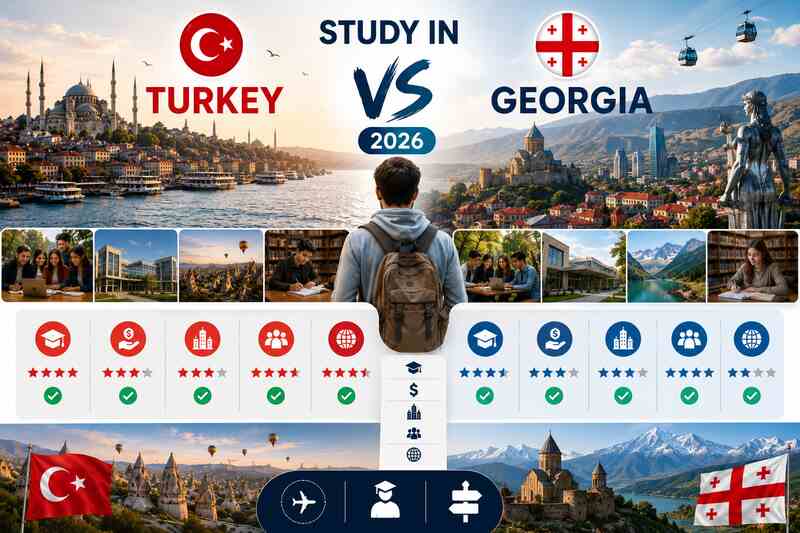
A lot of students end up comparing Turkey and Georgia because the pitch sounds almost identical: affordable tuition, English-taught programs, no entrance exams, friendly visa process, Muslim-friendly environment, and a city that's genuinely liveable. Both countries are small enough to be overlooked by mainstream study-abroad guides and large enough to have built real university infrastructure over the past two decades.
But they're not the same destination, and the differences matter a lot depending on what you're studying, where you're from, and what you plan to do with your degree.
I've been in Istanbul working with international students at Imtiyaz Education since 2005. We place students exclusively in Turkey and Northern Cyprus, so I have no financial reason to push Turkey in this comparison. What I can offer is an honest breakdown of both options across the factors that actually drive real decisions tuition, living costs, accreditation, post-graduation recognition, city experience, and long-term value.
Let's go through it.
The Basic Setup: Turkey and Georgia as Study Destinations
Turkey has 208 higher education institutions, over 300,000 international students, and a well-established private university sector that has been actively recruiting internationally since the early 2010s. Istanbul, Ankara, and Izmir are the main student cities. Istanbul alone is home to dozens of private universities with English-taught programs spanning medicine, engineering, dentistry, pharmacy, business, and the social sciences.
The country is regulated by YÖK (Yükseköğretim Kurulu), which registers and oversees all universities. Program-level accreditations TEPDAD for medicine, MÜDEK for engineering give Turkish degrees internationally verifiable quality benchmarks.
Georgia (the Caucasian country, not the US state) has been a growing study destination since around 2010, driven almost entirely by its medical education sector. Tbilisi, the capital, houses most of the major universities. Georgia follows the Bologna Process, meaning its degrees fit within the European Higher Education Area framework. The country has over 21,000 foreign students, with the largest groups coming from India, Iran, and parts of Africa and the Arab world.
Georgia's accreditation body is the National Center for Educational Quality Enhancement (NCEQE). Medical schools are additionally accredited or recognized by WHO, WDOMS, ECFMG, and the National Medical Commission of India (NMC for Indian students).
Both countries target a similar student profile. But what they actually offer is quite different.
Tuition Fees: Turkey vs Georgia
Turkey; private university tuition (2026-2027):
General undergraduate programs (business, law, social sciences): $3,000 - $7,000/year
Engineering (MÜDEK-accredited programs): $4,000 - $10,000/year
Medicine (English-taught MD, 6 years): $8,000 - $20,000/year
Dentistry: $7,000 - $15,000/year
Pharmacy: $5,000 - $10,000/year
State universities in Turkey charge significantly less sometimes $500-$3,000/year but require TR-YÖS exam results for most programs.
Merit scholarships of 25-50% are common at Turkish private universities, especially through agency partnership agreements. At Imtiyaz Education, we assess scholarship eligibility for every student we work with at no cost.
Georgia; university tuition (2026-2027):
General undergraduate programs (business, engineering, IT): $2,500 - $5,000/year
Medicine and Dentistry: $4,000 - $8,000/year
Average across all program types: $3,000 - $6,000/year
Georgia is genuinely cheap. The medicine tuition figures are lower than Turkey's across most institutions, which is why Georgia became the dominant destination for budget-conscious medical students particularly from India, where the combination of low fees and NEET exemption (you don't need NEET to apply, though Indian students still need to clear FMGE or NExT to practice at home) was a major draw.
What the tuition comparison actually shows:
For non-medicine programs, Georgia and Turkey are broadly comparable on tuition, with Georgia having a slight edge at the bottom of the range. For medicine, Georgia is meaningfully cheaper a full 6-year MD in Georgia runs $24,000-$48,000 in total tuition, versus $48,000-$120,000 in Turkey (before scholarships). That's a real difference.
But tuition is only one input. Living costs, degree recognition, city infrastructure, and post-graduation outcomes fill out the rest of the picture.
Living Costs: Istanbul vs Tbilisi
Tbilisi (Georgia):
Georgia has one of the lowest costs of living of any university destination in Europe or the broader region:
Student accommodation (shared room): $150 - $350/month
Food: $100 - $200/month
Transport: $15 - $25/month
Realistic total: $250 - $500/month
A student living modestly in Tbilisi can get by on $300/month comfortably. Even a generous lifestyle budget rarely exceeds $500/month. Over a 6-year medicine program, total living costs in Tbilisi might run $18,000-$36,000.
Istanbul (Turkey):
Istanbul costs more than Tbilisi, though it's still affordable by international standards:
Shared apartment (student districts like Fatih, Beyazıt, Esenyurt): $200 - $400/month
Food: $150 - $250/month
Transport: $20 - $40/month
Realistic total: $400 - $700/month
Over 6 years, Istanbul living costs typically run $28,000-$50,000.
The living cost gap:
Over a full medicine program, Georgia costs roughly $10,000-$20,000 less in living expenses than Turkey. Combined with the tuition gap, a student studying medicine in Georgia vs Turkey might save $30,000-$60,000 in total program cost a substantial difference that explains why Georgia has attracted so many medical students.
For non-medicine programs, where tuition in both countries is broadly comparable, the living cost advantage still favors Georgia, but the gap is more modest.
Accreditation and Degree Recognition: The Critical Difference
This is where the two countries separate most meaningfully and where most comparison articles fail to go deep enough.
Medical degrees: The FMGE/NExT problem for Indian students in Georgia
Georgia's rise as a medical education hub was driven heavily by Indian students. And this is where the honest truth matters most.
A 2025 study published in Current Sociology by Ginnerskov-Dahlberg followed Indian medical students in Georgia through ethnographic fieldwork between 2021 and 2024. The findings are sobering: despite investing six years in a Georgian medical degree, the students face a rigorous, highly competitive screening test upon return to India the FMGE (Foreign Medical Graduate Examination), now being replaced by NExT with a very low pass rate. The study describes this journey as a "high-risk educational strategy" where the anticipated medical licence remains far from assured. Many students arrive in Georgia hoping their degree will function as an "escalator" for social mobility but the outcome is uncertain, and the risk is real.
This is not a reason to dismiss Georgian medical education entirely. WDOMS-listed Georgian medical schools are recognized in many countrie and students who clear their home country's licensing exam are able to practice. The problem is that pass rates for foreign medical graduates returning to compete in highly selective licensing environments (India, Pakistan, Bangladesh, and others) have historically been low. The degree is recognized; passing the exam required to use it is the harder part.
What does accreditation actually mean here?
A 2022 study in BMC Medical Education by van Zanten et al. found that international medical students who attended schools accredited by WFME-recognized agencies had higher or comparable USMLE first-attempt pass rates compared to those who attended non-WFME-accredited schools. This underscores that accreditation isn't just a checkbox it's correlated with actual educational outcomes and graduate performance on licensing exams.
Turkey's top medical schools hold TEPDAD accreditation, which is recognized by the World Federation for Medical Education (WFME). Georgian medical schools vary the established names like Tbilisi State Medical University (TSMU) and David Tvildiani Medical University are WDOMS-listed and WHO-recognized. But Georgia has seen rapid proliferation of private medical schools over the past decade, and quality varies considerably between institutions.
For engineering, business, and other fields:
Georgia follows the Bologna Process, which gives its non-medicine degrees European framework recognition. Engineering graduates from Georgian Technical University can in principle seek recognition in European countries. But Georgia does not have a Washington Accord-equivalent for engineering unlike Turkey, whose MÜDEK has been a Washington Accord full signatory since 2011. This means MÜDEK-accredited Turkish engineering degrees are explicitly recognized as equivalent to ABET-accredited programs in the US, UK, Canada, Australia, and 20+ other countries. Georgia's engineering degrees require country-by-country recognition assessment without that blanket equivalence.
For business, neither country has strong AACSB or EQUIS coverage. Both are comparable here.
The Universities: Side-by-Side
Factor | Turkey | Georgia |
|---|---|---|
Total universities | 208 | ~24 state + 81 private |
International students | 300,000+ | 21,000+ |
Main student city | Istanbul (also Ankara, Izmir) | Tbilisi (also Batumi) |
Medicine tuition | $8,000-$20,000/year | $4,000-$8,000/year |
Non-medicine tuition | $3,000-$9,000/year | $2,500-$5,000/year |
Living costs/month | $400-$700 | $250-$500 |
Medical accreditor | TEPDAD (WFME-recognized) | WHO, WDOMS, ECFMG |
Engineering accreditor | MÜDEK (Washington Accord) | Georgian Technical, no Washington Accord |
Bologna Process | Yes | Yes |
Part-time work permitted | Yes (with work permit) | Yes (no hour limit officially) |
Post-study work visa | No dedicated scheme | No dedicated scheme |
QS World Ranking (top institutions) | Koç, METU, Boğaziçi in top 500 | Tbilisi State ~951-1000 |
Scholarship availability | 25-50% common via agencies | Less standardized |
Agency support (free) | Yes — Imtiyaz Education | Not applicable |
Medicine
Turkey; Istanbul Medipol University TEPDAD-accredited, WDOMS-listed, hospital-integrated clinical training on campus. English-taught MD program. Annual tuition approximately $15,000-$18,000. One of the strongest medical education environments in Turkish private higher education.
Turkey; Biruni University WDOMS-listed. Modern campus, English MD track. Approximately $10,000-$14,000/year. Strong clinical network.
Turkey; Istanbul Aydin University WDOMS-listed. More affordable medicine option with English and Turkish tracks. Approximately $8,000-$12,000/year.
Georgia; Tbilisi State Medical University (TSMU) The flagship Georgian medical school. WHO-recognized, WDOMS-listed, ECFMG-eligible. One of the most established and internationally recognized medical institutions in the region. Tuition approximately $5,000-$7,000/year.
Georgia; David Tvildiani Medical University Private, WDOMS-listed, well-regarded for USMLE preparation culture. Tuition approximately $6,000-$8,000/year.
Georgia; European University (Tbilisi) Popular among international students. More affordable at approximately $4,000-$5,000/year. Accredited and WDOMS-listed, but a newer institution compared to TSMU.
Honest assessment for medicine: Georgia's top medical schools (TSMU, David Tvildiani) are legitimate and competitive at roughly half the tuition of equivalent Turkish programs. The question isn't whether the Georgian degree is real it is. The question is what happens after graduation in the specific country where the student plans to practice. Students who can clear their home licensing exam will have a fully usable degree. Students in high-competition licensing markets (India, Bangladesh) face a real risk documented in peer-reviewed research.
Turkey's TEPDAD/WDOMS-listed schools offer comparable or stronger accreditation credentials in some markets, with tuition that is meaningfully higher but still a fraction of Western medical education costs.
Engineering
Turkey; Bahçeşehir University (BAU) MÜDEK-accredited on select engineering programs. English-taught. Istanbul campus. $8,000-$12,000/year. Washington Accord recognition in 20+ countries.
Turkey; Istanbul Aydin University MÜDEK accreditation on specific programs. More affordable at $4,000-$7,000/year. Good for students who confirm MÜDEK status on their specific program before applying.
Georgia; Georgian Technical University Georgia's main state engineering institution. Bologna Process-compliant. European recognition framework. Tuition approximately $3,000-$5,000/year for international students. No Washington Accord membership.
Honest assessment for engineering: Turkey has a structural accreditation advantage through MÜDEK and the Washington Accord. If global engineering mobility particularly to the US, Canada, UK, or Australia is the career goal, MÜDEK-accredited Turkish programs are meaningfully better positioned. For students whose career will stay in their home country or in European markets, Georgia's Bologna Process alignment may be sufficient.
Business, IT, and Social Sciences
For non-professional programs where specific international accreditation is less critical, both countries offer solid options at comparable quality and significantly different prices:
Turkey: Istanbul Aydin University, Istanbul Gelisim University, Nisantasi University business, computer science, social sciences from $3,000-$6,000/year.
Georgia: University of Georgia (UoG), Caucasus University, Georgian American University business, IT, international relations from $2,500-$4,500/year.
Georgia is cheaper here, but the Turkish institutions sit in a larger city with more industry exposure, more international students, and more established alumni networks.
Tbilisi:
Tbilisi is a genuinely beautiful city compact, walkable in many areas, historically rich, and increasingly cosmopolitan. The international student community is visible and growing. Food is varied and cheap. Public transport is functional and affordable. The city is considerably safer than its geographic position might suggest, with very low crime rates.
But Tbilisi is small by global standards. Career networking opportunities are limited compared to a major metropolis. The Georgian language is required for any meaningful integration beyond the international student bubble. And for students from Muslim-majority countries, while Georgia is generally welcoming and tolerant, halal food availability and Islamic cultural infrastructure are more limited than in Istanbul.
Istanbul:
Istanbul is one of the most consequential cities in the world geographically, historically, and economically. For international students from the Arab world, Central Asia, and Africa, it's a familiar cultural environment: halal food everywhere, large diaspora communities, mosques in every neighborhood, and a population that has absorbed millions of foreign students and workers over decades.
Career exposure in Istanbul is real. The city is a financial, logistics, and technology hub. Students who build networks during their studies have access to Turkey's significant job market and, increasingly, connections to the broader region.
The tradeoff is cost. Istanbul is more expensive to live in than Tbilisi, and the bureaucratic processes residence permit, document translation, initial registration are more complex. That's exactly why Imtiyaz Education's on-ground support matters: we pick students up from the airport, accompany them to the university for registration, and handle the residence permit process with them step by step. Students who come through us don't navigate Istanbul's systems alone.
Choose Georgia if:
Medicine is your program and budget is the primary constraint
Your home country's licensing exam has a reasonable pass rate for foreign medical graduates (and you've researched this specifically)
You're comfortable with Tbilisi's smaller scale and international community
You don't need the on-ground support infrastructure that agencies like Imtiyaz provide in Istanbul
Saving $30,000-$60,000 over the full program is genuinely transformative for your family's financial situation
Choose Turkey if:
You're studying engineering and want Washington Accord recognition through MÜDEK
You want the Istanbul city experience cultural familiarity, halal environment, diaspora community, urban career exposure
You want on-ground agency support from arrival through to residence permit and beyond (which Imtiyaz Education provides at no cost)
Your scholarship application reduces the tuition gap significantly
You're studying non-medicine programs where Turkey's larger university sector offers more institutional variety
Medicine is your program and your home country licensing environment favors graduates from TEPDAD/WDOMS-listed Turkish institutions specifically
We operate two physical offices in Istanbul. Our staff includes former international students who went through Turkey's university system themselves people who have personally navigated the residence permit process, course registration, document translation, and the first semester shock of living in a new country.
For students who apply to Turkish universities through us, the process is genuinely free. We don't charge application fees. We don't charge agency fees. Universities pay us a commission when students enroll — which means we only get paid when students succeed. Our incentive is completely aligned with finding the right program for each student, not pushing the highest-commission university.
We verify TEPDAD and WDOMS status for every medicine program, MÜDEK accreditation for every engineering program, and YÖK registration for every institution before we recommend it. We submit applications and receive offer letters typically within 24-72 hours. We coordinate airport pickup on arrival day, accompany students to university for final registration, and assist with the first residence permit application through our Turkish-court-accredited sworn translation office.
If you're deciding between study in Turkey vs Georgia and Turkey fits your situation better, apply through turkeyuniversity.org. The process is free, fast, and you won't be alone in Istanbul from day one.
Q: Is Georgia or Turkey cheaper for studying medicine? A: Georgia is cheaper on both tuition and living costs. Total medical education cost (tuition + living) in Georgia typically runs $40,000-$75,000 over six years. In Turkey, the equivalent figure is $70,000-$150,000 depending on the university and scholarship situation. If cost is the primary factor, Georgia has a clear advantage for medicine.
Q: Are Georgian medical degrees recognized internationally? A: Georgia's major medical schools particularly Tbilisi State Medical University, David Tvildiani Medical University, and a few others are WHO-recognized and WDOMS-listed. This means graduates can attempt licensing exams in countries that accept WDOMS-listed school graduates, including the US (USMLE via ECFMG), the UK (subject to GMC requirements), and many others. Recognition exists; passing the licensing exam in competitive markets is a separate challenge that research shows carries significant risk for some student populations.
Q: Which country is better for engineering, Turkey or Georgia? A: Turkey has a structural advantage through MÜDEK, its Washington Accord-signatory engineering accreditor since 2011. MÜDEK-accredited Turkish engineering programs are recognized as equivalent to ABET-accredited programs in 20+ countries. Georgia does not have Washington Accord membership for engineering, meaning Georgian engineering degrees require country-by-country recognition assessment. For students targeting career mobility in the US, Canada, UK, or Australia, Turkey's MÜDEK programs have a clear edge.
Q: Is it safe to study in Georgia? A: Yes. Georgia consistently ranks among the safest countries in the Caucasus and Eastern Europe region. Tbilisi has very low street crime rates, and the international student community is well-established and integrated. Safety is not a meaningful differentiator between Turkey and Georgia both countries have solid safety track records for international students.
Q: Can international students work while studying in Georgia? A: Officially, Georgia has no hour limit on part-time work for international students unlike many European countries. In practice, work opportunities for non-Georgian speakers are limited, and the job market is small. Students should not count on work income to subsidize their studies in a meaningful way. Turkey similarly allows international student work with a work permit, though enforcement is inconsistent.
Q: Does Imtiyaz Education help with admissions to Georgia? A: No. Imtiyaz Education specializes in Turkey and Northern Cyprus. For students seriously considering Georgia, we advise researching directly through Tbilisi State Medical University, David Tvildiani, or reputable Georgian-focused agencies. For Turkey, we're here: apply free at turkeyuniversity.org or contact us directly at info@imtiyazeducation.com.
Q: How do I verify if a Georgian medical school is WDOMS-listed? A: You can search directly at search.wdoms.org. Enter the university name or country (Georgia) and verify that the specific school appears in the directory. This check should be done before accepting any offer from a Georgian university, as not all private medical schools in Georgia are listed.