Disability and Accessibility Services at Turkish Private Universities — What International Students Need to Know in 2026

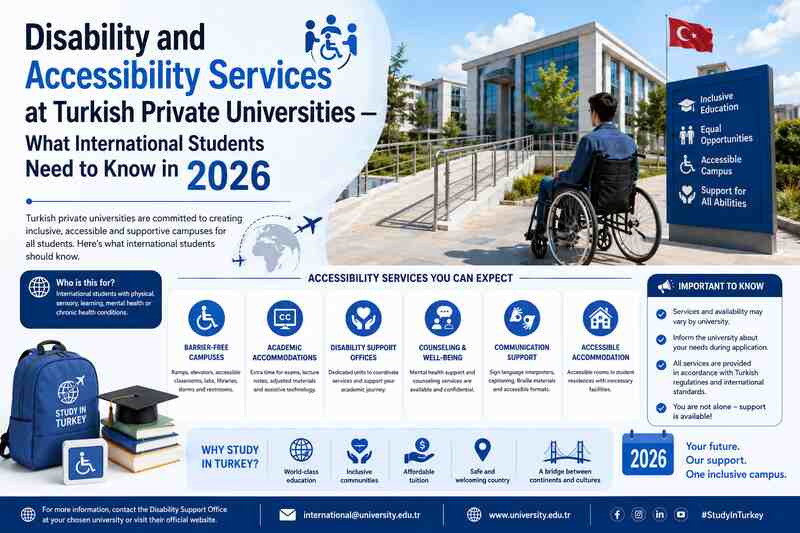
This is a topic that almost no study-abroad content about Turkey covers properly. You'll find dozens of articles comparing tuition fees, ranking Turkish medical schools, explaining the ikamet application process. But when a student with a physical disability, a learning difference like dyslexia or ADHD, or an ongoing mental health condition asks us "can I actually be supported at a Turkish university?" the answer requires a more specific, honest conversation than most guides provide.
So here it is. The real picture of disability services for international students, physical accessibility, learning accommodations, and mental health support at Turkish private universities in 2026 written for international students who need accurate information before they enroll, not after.
The Legal Framework; What Turkish Law Actually Requires
Turkish higher education institutions are legally required to provide disability support under the YÖK Disability Consultation and Coordination Regulation (Yükseköğretim Kurumları Engelli Danışma ve Koordinasyon Yönetmeliği), which came into force in 2020. This regulation mandates that every higher education institution in Turkey establish a dedicated disability support unit, identify the academic, physical, housing, and social needs of students with disabilities, and develop and implement plans to meet those needs.
YÖK, Turkey's Higher Education Council runs an annual "Engelsiz Üniversite" (Barrier-Free University) Awards program that evaluates and publicly recognizes universities on two main dimensions: physical accessibility (Orange Flag) and educational accessibility (Green Flag). This is not a marketing scheme it's a formal YÖK evaluation that creates real institutional accountability. Universities that want to be seen as disability-inclusive actively compete for these awards, and the process requires documenting actual provisions, not intentions.
The practical implication for international students: disability support at Turkish private universities is not informal or dependent on individual faculty goodwill. It is regulated, institutionally required, and increasingly evaluated publicly. That's a meaningfully different situation from what exists in many other study-abroad destinations in the region.
Physical Accessibility on Campus; The Honest Range
Turkey's major private universities have invested significantly in physical accessibility compliance since the 2020 YÖK regulation came into effect. Istanbul Medipol, Bahçeşehir (BAU), Istanbul Bilgi, and Istanbul Gelişim campuses have ramp access, elevator access, accessible toilets, and reserved parking at most main buildings. Istanbul Atlas University has specifically cited its work toward "Barrier-Free University" status across its faculties, with dedicated engelsiz erişim (accessible access) infrastructure across its medicine, dentistry, engineering, and social sciences buildings.
That said, there are real limitations worth knowing about. Some private universities use multiple campus buildings including older structures in historic Istanbul neighborhoods that have not been fully retrofitted for wheelchair access or other mobility accommodations. Istanbul Bilgi University, for instance, operates across multiple campuses including its santralistanbul location, where some older buildings have more limited physical accessibility than purpose-built modern campuses. The same applies to other universities that lease space in existing Istanbul buildings rather than operating purpose-built campus facilities.
The practical guidance: do not rely on a university's general marketing description of its campus as "fully accessible." Contact the specific university's engellilik birimi (disability support unit) directly before enrollment, describe your specific physical requirements, and ask which buildings your program will use and whether those specific buildings meet your needs. Most disability units respond in both Turkish and English and are genuinely helpful when asked concrete questions.
For students using wheelchairs or mobility aids, the on-campus question is only part of the picture. Istanbul's broader physical geography uneven cobblestones in older neighborhoods, hilly terrain in many districts, crowded public transport during peak hours adds a layer of daily navigation complexity that doesn't exist on most purpose-built Western university campuses. Students with significant mobility requirements should consider campus location carefully: universities on flatter terrain with direct access to accessible metro or bus lines will be significantly easier to navigate day-to-day than those in hillier or more congested districts.
Learning Support and Academic Accommodations
Every major Turkish private university is required by the 2020 YÖK regulation to have an engellilik birimi a disability support unit that manages academic accommodations. In practice at established private universities, these units provide:
Extended examination time: the most commonly requested accommodation and the most consistently delivered. Students with documented learning differences (dyslexia, processing difficulties, ADHD), chronic health conditions, or physical disabilities that affect written examination performance can request extra time through the disability unit. Documentation of the condition is required — usually a medical report or educational psychologist's assessment from your home country, translated into Turkish or English.
Assistive technology access: most university libraries and computer labs at major institutions have screen reader software, magnification software, and other assistive technologies available. The range varies by institution; confirm the specific tools available if you have particular technology requirements.
Note-taking support and recording permissions: students who have difficulty taking notes during lectures (due to motor difficulties, visual impairments, or auditory processing differences) can request either note-taking support from the disability unit or permission to record lectures for personal study use. These are standard accommodations at most major private universities.
Individual academic support: the disability unit typically coordinates between the student and individual faculty members to ensure awareness of accommodations without disclosing more than the student wishes to share. Faculty are not always automatically informed of a student's specific disability only of the accommodations they are required to provide.
Important for international students: disability documentation from your home country is accepted but may need to be translated and in some cases assessed by a Turkish medical professional, particularly for conditions not specifically defined in Turkish medical classification systems. Starting this documentation process early before you arrive removes delays and ensures accommodations are in place from the beginning of your first semester, not three months into it.
This is something we help students navigate at Imtiyaz Education. We know which universities have the most responsive disability units for international students, what documentation formats work most smoothly, and how to initiate the process through the right contact at each institution.
Mental Health Services; What Exists and What to Know
Turkish private universities increasingly offer psychological counseling services psikolojik danışmanlık either as standalone counseling centers or as part of student support departments. For international students, the language of service matters.
At universities with large international student populations Istanbul Medipol, BAU, Bilgi, and a few others English-language counseling is available or can be arranged. At smaller or more domestically-focused institutions, psychological services are typically provided in Turkish only. This is not a policy decision against international students it reflects the language capacity of counseling staff. But it does mean that a student experiencing serious mental health difficulties who is not proficient in Turkish may not be able to access the most immediate campus-based support.
For English-language mental health support beyond campus services, Istanbul has a strong international hospital infrastructure. Koç University Hospital, Florence Nightingale Hospital, and American Hospital Istanbul all have English-speaking psychiatric and psychology departments. These are private hospitals with associated costs, but for international students in serious need of English-language psychiatric support, these are reliable, accessible options. Health insurance for international students in Turkey is required and generally covers outpatient specialist consultations review your policy for psychiatric coverage before you need it.
It's also worth knowing that international student isolation particularly in the first two to three months of a new country is one of the more common triggers for mental health difficulties among students who had no prior history of mental health conditions. We talk about this directly with students we work with, because being honest about the adjustment curve is part of responsible student support. If you have an existing mental health condition and are planning to study in Turkey, the two most important steps are: confirm English-language counseling availability at your specific university before you enroll, and establish contact with an English-speaking mental health professional in Istanbul before you need one in a crisis.
Sensory Disabilities; Visual and Hearing Impairment Provisions
Students with visual impairments can access assistive technology through most major university libraries, as noted above. Some universities also offer document conversion services producing course materials in accessible formats (large print, digital text) for students with visual impairments. This is not universally available and needs to be confirmed in advance.
For students with hearing impairments, Turkish Sign Language (Türk İşaret Dili, TİD) interpretation is not routinely available at most private universities for academic instruction. Some universities can arrange interpretation for key administrative processes enrollment, ikamet support, university meetings but TID interpretation as a standard academic accommodation for regular lecture attendance is not yet widely established in the Turkish private university system. Students with significant hearing impairments should discuss this gap directly with the disability unit of any university they're considering, and in most cases should be prepared to supplement with captioning tools or note-taking accommodations.
What to Ask Before You Enroll; A Practical Checklist
If you have a disability or health condition that may require accommodation at a Turkish private university, these are the questions to ask the engellilik birimi before you commit:
Which buildings does my specific program use, and are all of them physically accessible for my needs?
What documentation do you require to establish accommodations, and in what language?
Is English-language psychological counseling available on campus?
What assistive technologies are available in campus libraries and computer labs?
How far in advance of enrollment should I submit my accommodation request?
Who is my named disability support contact throughout my degree?
Most major Turkish private universities will answer these questions clearly. If a university's disability unit cannot or will not answer them before enrollment that's information too.
How Imtiyaz Education Supports Students with Disabilities
We've helped students with physical disabilities, learning differences, and mental health conditions enroll in Turkish private universities. What we know from that experience: the process works much better when it starts early, when documentation is prepared correctly before arrival, and when someone is on the ground in Istanbul who can follow up in person when the university's administrative processes need a push.
When we receive students at the airport and walk them through their first week in Istanbul ikamet application, housing setup, health insurance, bank account we're also thinking about the specific needs of each student. For a student with a physical disability, that means confirming their accommodation is genuinely accessible before we take them there. For a student with a mental health history, that means making sure they have the right contacts in Istanbul from day one.
The consultation with our team is free. The application through us costs nothing. And the on-ground support is the same for every student which, for students with additional support needs, matters more than it does for anyone else.
Reach out through turkeyuniversity.org and tell us your situation. We'll give you an honest answer.